At the start of 1970 BRM stood at a turning point. The team from Bourne had not won a Grand Prix since Jackie Stewart's victory at Monaco in 1966. The old V16 was long forgotten, the H16 had proved a failure, and the years that followed had been a string of mediocre results. Tony Southgate, newly brought in as designer, was given a single brief: build a car that puts the team back at the front.
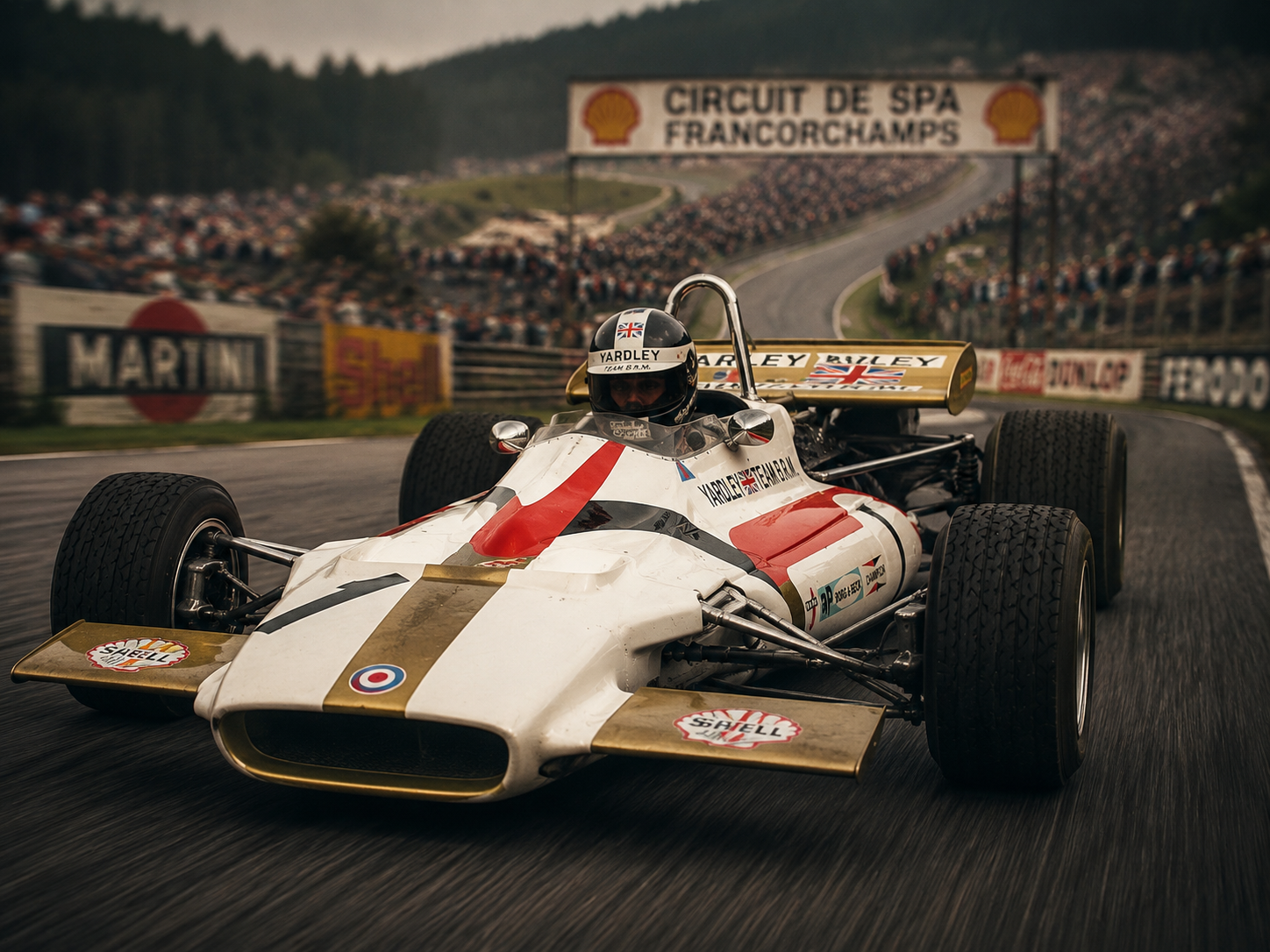
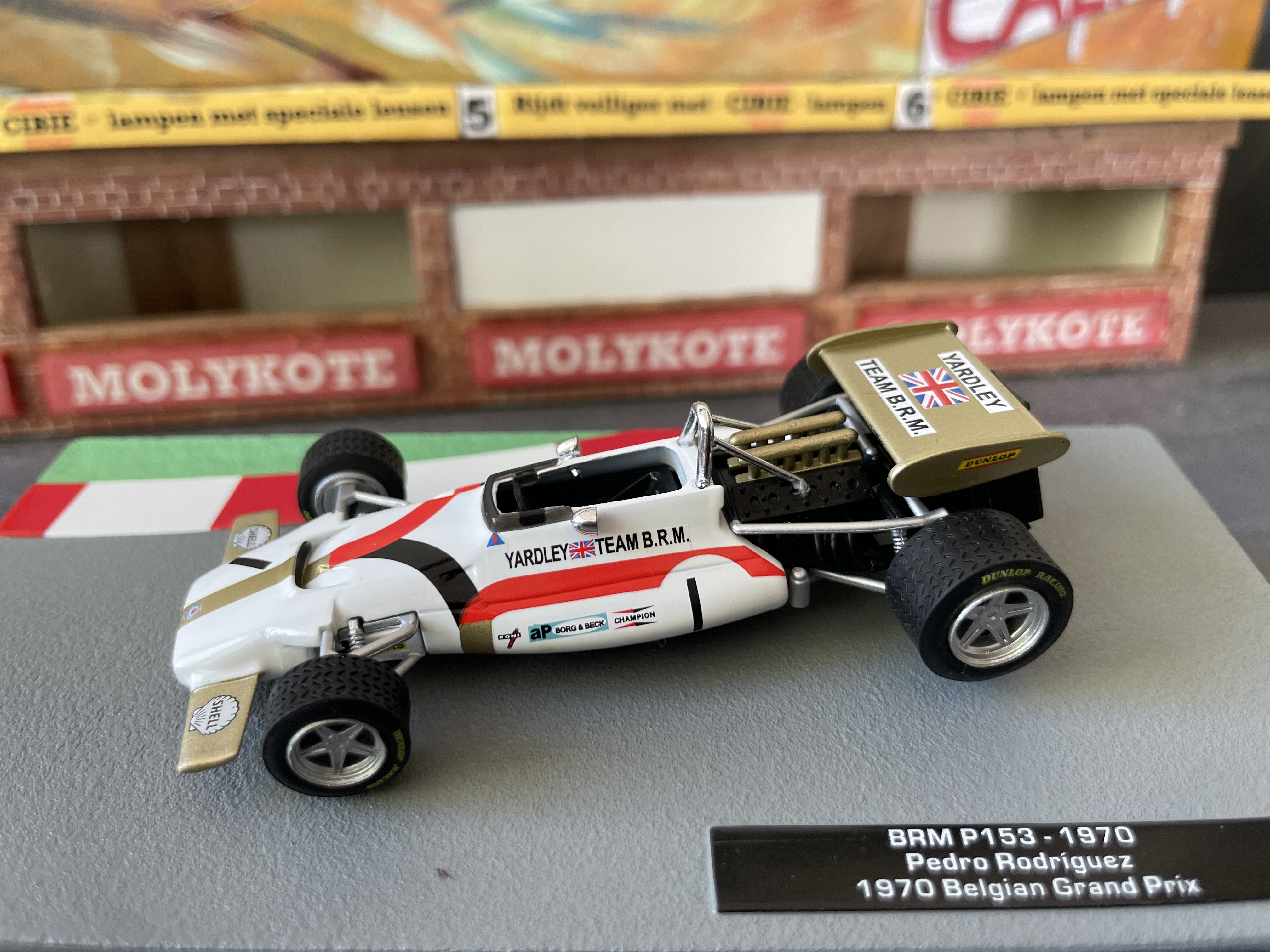
What he drew was the P153 — a low, angular monocoque with BRM's own 3.0-litre V12 behind the driver. At the start of 1970 the team still raced the car under the old name Owen Racing Organisation, in the classic dark green BRM livery. But early in the season the cosmetics firm 'Yardley of London' arrived with a sponsorship deal. The car got a new white-and-red livery with a gold accent, and the team became Yardley Team BRM — for the company a break with its history and at the same time a fresh start. Pedro Rodríguez returned to the team he had already driven for once in '68, now alongside Jackie Oliver.
In 1970 Spa-Francorchamps was still the old version: 14.1 kilometres through the Ardennes, with speeds well above 300 km/h through Burnenville and Masta. It was notorious and dangerous — after his own accident there in '66, Stewart had criticised it openly for years and lobbied for change. Nobody knew it at the time, but this would be the very last Formula 1 race on the old layout. From 1971 Spa was off the calendar, and F1 did not return until 1983 — on a shorter, safer layout.
On 7 June Rodríguez started sixth. On the opening lap he worked his way forward — by lap four he was second, behind Chris Amon in the March 701. On lap six he passed Amon on the straight before Stavelot and took the lead. What followed was an hour-and-a-half chase in which Amon was never more than a few seconds behind him. Pedro set a lap of 3 minutes 30.8 seconds — an average of 241 km/h, the fastest in Formula 1 history up to that point. At the finish he crossed the line 1.1 seconds ahead of Amon.
It was BRM's first win in four years and, above all — though nobody knew it then — Pedro Rodríguez's last in Formula 1. That season he still finished second at Watkins Glen (where his car crossed the line almost out of fuel) and fourth in Austria. On 11 July 1971 he was killed at the Norisring during an Interserie race, in a Ferrari 512M that suddenly lost a wheel. He was 31.
This model stands in my display cabinet as a monument to a driver from an era when Formula 1 was still raw, dangerous and, above all, a sport for those who truly dared. Pedro dared. And on 7 June 1970 he was the fastest of them all.