At the start of 1972 BRM stood at a crossroads. For years the British team had built its own engine — an idiosyncratic 3.0-litre V12 that was impressive on paper, but in practice always lacked a little in reliability and power compared with the universally respected Cosworth DFV. For the 1972 season team boss Louis Stanley had landed a first: Marlboro signed as title sponsor, the first cigarette manufacturer ever to fund an F1 team. With that money Stanley entered five, sometimes six cars at once, a mix of P153s, P160Bs and the new P180s. It was a team pulling in every direction at the same time.
Beltoise came over from Matra. He was France's great hope — a former motorcycle racer who had a serious accident at Reims in 1964 that left his left arm permanently weakened. He raced with one good arm and half of another, and refused to accept that as an excuse. At BRM he was given number 17 and the P160B, the further developed version of the car Pedro Rodríguez had driven so brilliantly the year before — until his fatal accident at the Norisring. The P160B was not fundamentally different from the original: new suspension, different fuel tanks, a few hundred grams lighter. Changes with which Tony Southgate had quietly made the car faster.
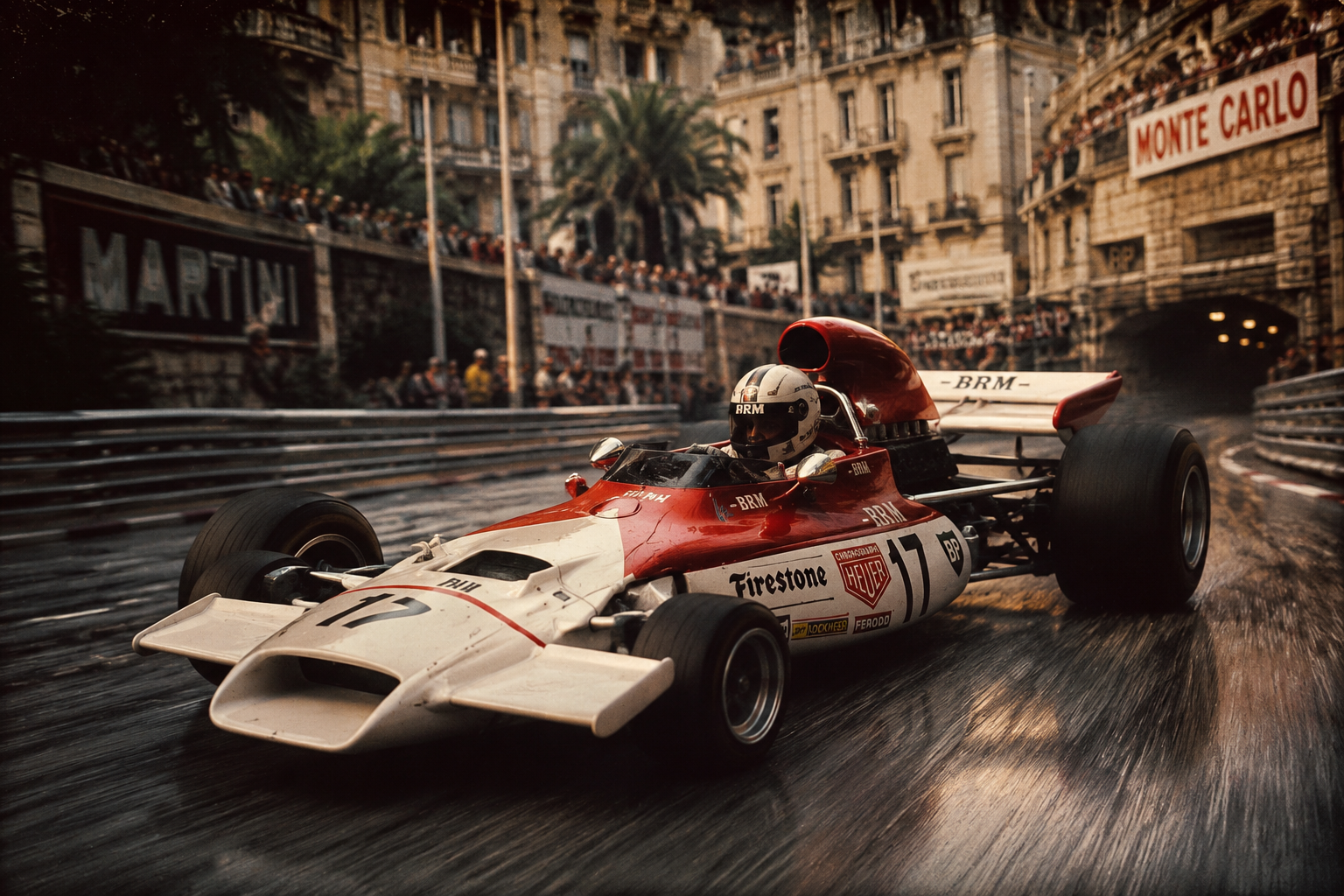
The season began dramatically. He missed Argentina because of technical problems; in South Africa he retired; in Spain the same. Then, on 14 May, came Monaco. On Sunday morning the heavens opened over Monte Carlo and the organisers briefly considered a postponement. The race went ahead, however. Beltoise had qualified on the third row, and in the first few metres, on the treacherously slippery tarmac towards Sainte Devote, he dived from fourth to first. And there he stayed. Eighty laps, two hours and twenty-six minutes, ahead of Jacky Ickx — known as a rain specialist — with Fittipaldi behind him. Once, at Portier, the rear stepped out. He caught it and drove on.
It was BRM's only win of that season and also their last in Formula 1. For the rest of the year Beltoise mostly collected modest finishes and retirements — fifteenth in France, eleventh in Britain, ninth in Germany, eighth at the Österreichring, eighth at Monza. Nine points in total, all of them scored on that one afternoon in Monaco. He finished eleventh in the world championship. For BRM, seventh place in the constructors' championship was too modest for what the team had once been; for Beltoise, Monaco was the high point of his F1 career. He would never win again.
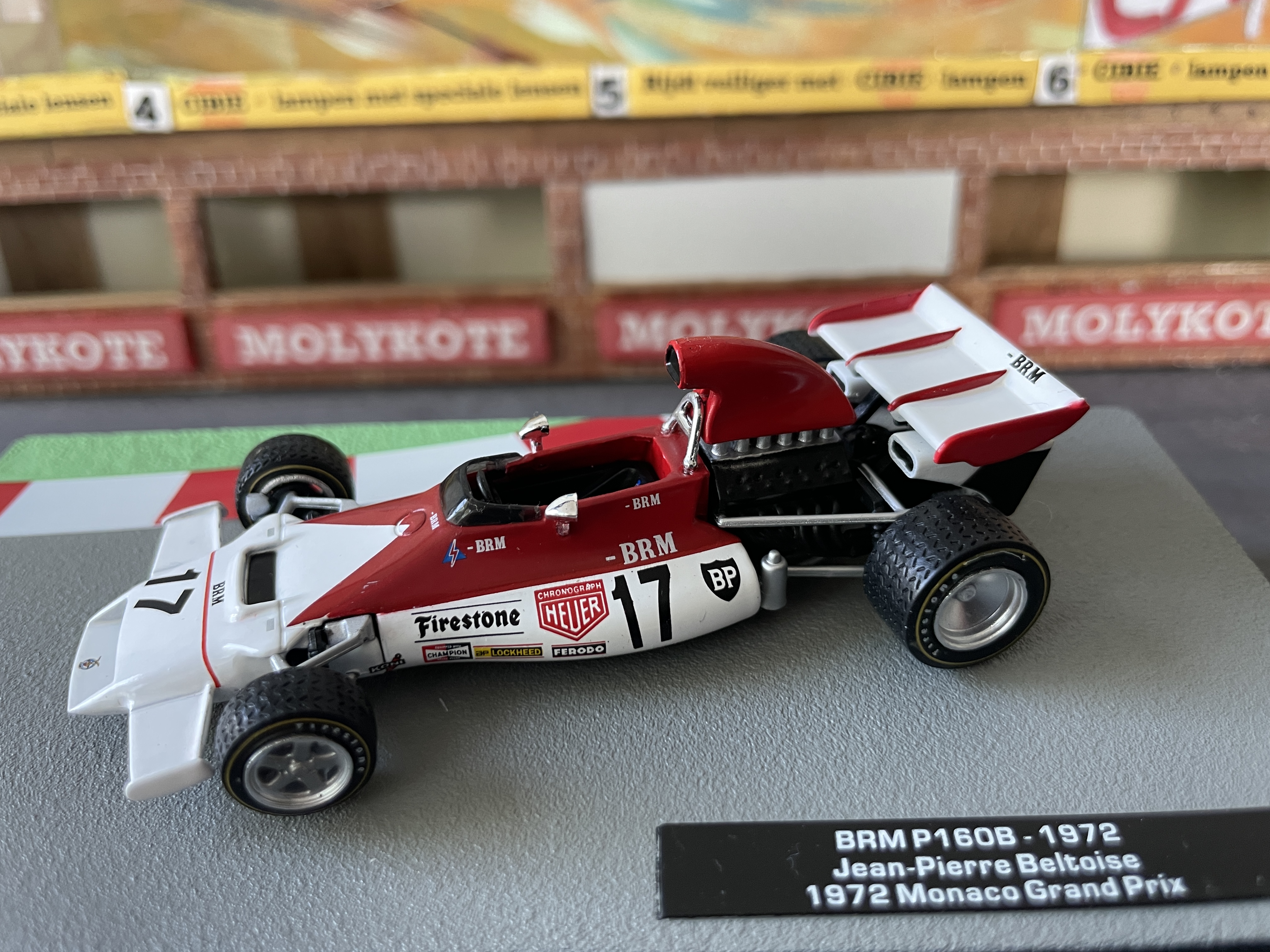
This model in my collection wears the Marlboro red and white, the broad number 17, and the separate Heuer, BP and Firestone decals of that season. The rear wing stands steeply upright — Monaco set-up. It is a quiet reminder of a race that should never have been possible, and that was won all the same.