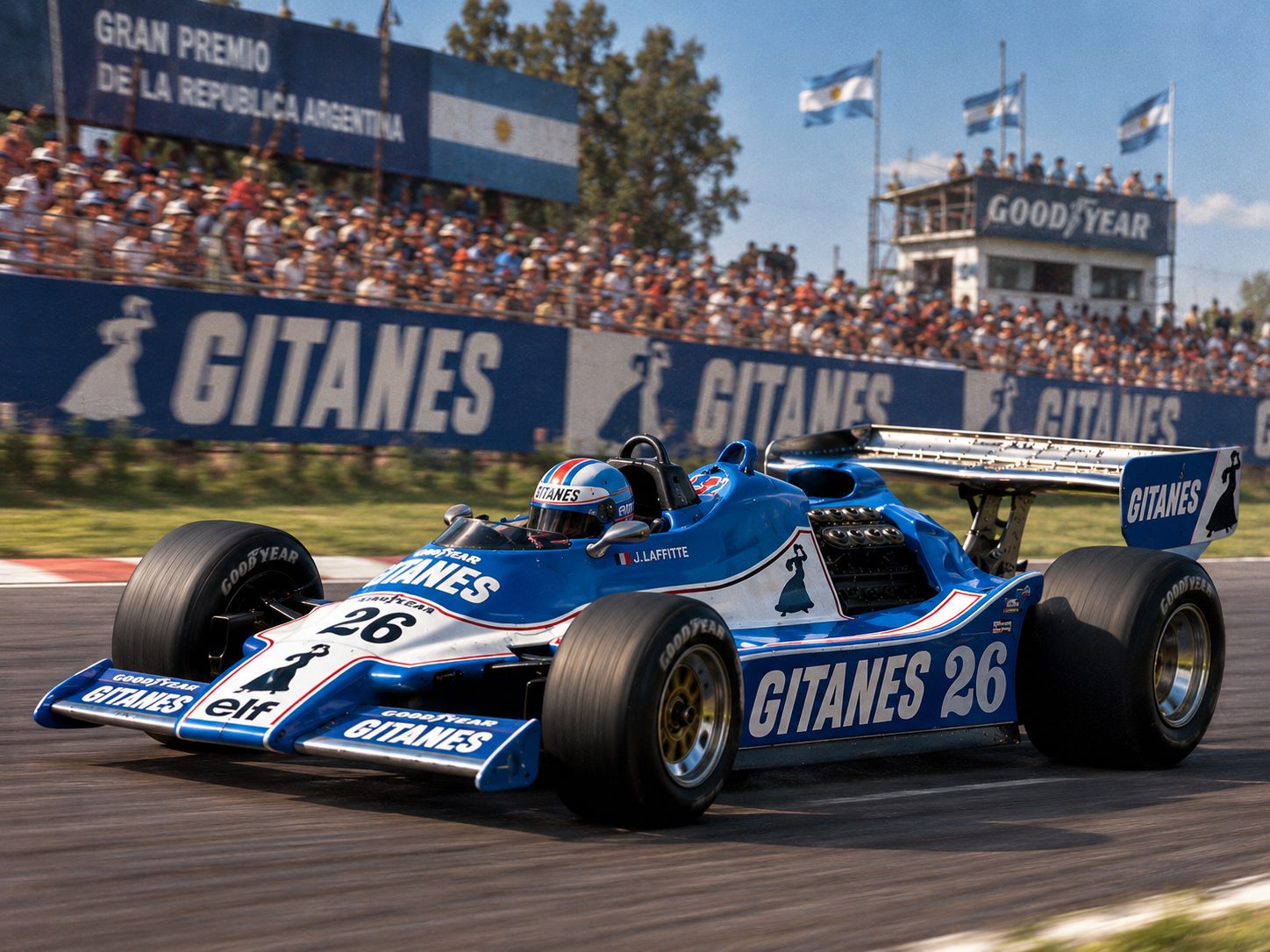
Guy Ligier was a rugby player, rower, road builder and amateur racing driver before he started a Formula 1 team. His first cars, the JS5 through to the JS9, carried the initials of his friend Jo Schlesser, who had been killed in an accident, and had a heavy Matra V12 behind the driver. That had produced one victory, in Sweden in 1977. For 1979 he changed course completely: out went the V12, in went the Ford Cosworth DFV, and technical director Gérard Ducarouge was given one winter to do what Colin Chapman had shown the way to with the Lotus 79 — build a car that sucks itself onto the tarmac.
The JS11 that emerged from Vichy was no copy. Ducarouge, Michel Beaujon and aerodynamicist Robert Choulet went further than Lotus. The venturi tunnels under the sidepods were more aggressively shaped, the springs and dampers were mounted vertically inside the monocoque so that nothing hung in the airflow, and the sliding skirts sealed so well that, in Ducarouge's words, no air escaped any more. The car produced so much downforce that the team hid a secret valve under a radiator which opened when the pressure got too high — otherwise the JS11 scraped along the ground at 265 km/h.
Jacques Laffite, 35 years old, brother-in-law of Jean-Pierre Jabouille and Ligier's regular driver since 1976, got in at Buenos Aires and was more than a second clear of the rest of the field. Pole. The first start ended in a huge pile-up in the fast sweepers after the pit lane — Scheckter, Piquet, Watson and Tambay ended up in the barriers — and at the restart Laffite simply drove away again. Fastest lap on lap 42, fifteen seconds ahead of Reutemann. Two weeks later at Interlagos, exactly the same: pole, fastest lap, victory, with Depailler second for a Ligier one-two. Two races, eighteen points, and the whole paddock wondering what was inside those blue cars.
The answer never came — because the advantage disappeared before anyone had worked it out. Between Brazil and South Africa the material of the undertray was changed; the new floor flexed under the aerodynamic load, the skirts lifted off the tarmac and the suction was gone. Laffite retired at Kyalami, Long Beach and Jarama, where Depailler did take the JS11's third win. In Belgium Laffite took his fourth pole of the season and finished second. Then, in early June, Depailler broke both legs in a hang-gliding accident, and Guy Ligier — furious about the disappointing results — had all the sidepods torn off and rebuilt in a fit of rage. The thirty-strong team did not have the resources to recover from that. Jacky Ickx came in to replace Depailler, Laffite finished third three times, and Williams and Ferrari took over for the rest of the year.
Fourth in the championship with 36 points, half of them from the first two races. Ligier finished third in the constructors' championship behind Ferrari and Williams. Laffite would eventually account for six of the nine Ligier victories ever — two of them in those six weeks of 1979 when he was, very briefly, the fastest driver in the world in the fastest car.
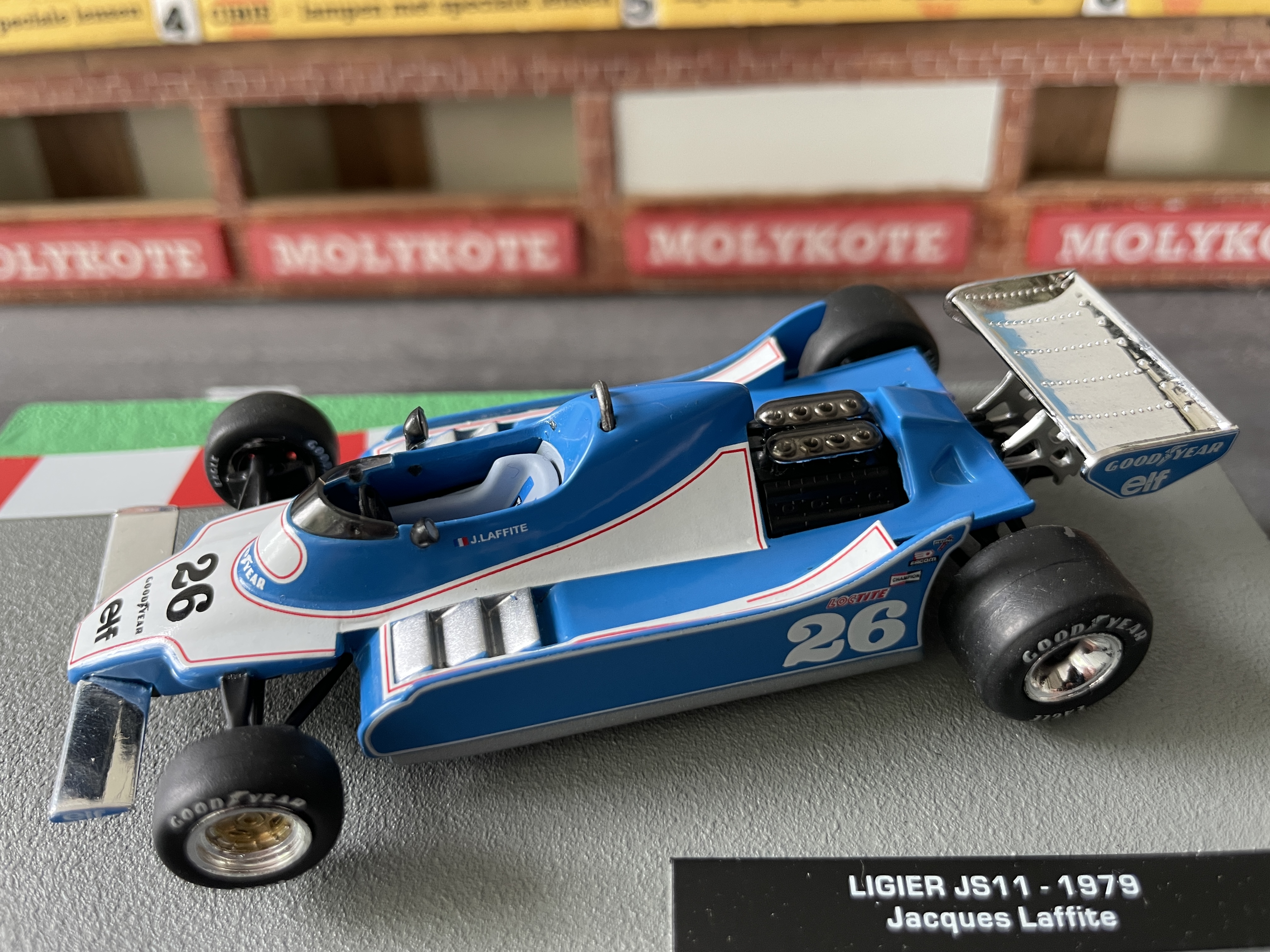
The model in my display cabinet comes from the F1 Collection series, issue 29, and shows the JS11 in French blue and white with the red pinstripes and number 26. Anyone who knows the real car will immediately see what is missing: the big Gitanes lettering on the sidepods and the nose. Tobacco advertising was no longer allowed on models, so those areas were left white. The gold wheels and the chrome wings are a liberty taken by the publisher — the real JS11 was more matt, heavier, and on those two afternoons in South America unbeatable.