By the start of 1995 Ligier had long ceased to be Guy Ligier's own proud French team. Flavio Briatore, the boss of Benetton, had bought a large share of it — and above all the Renault engines Ligier was entitled to. Those went to Benetton, where Michael Schumacher would win his second world title with them that year. In exchange Ligier got the Mugen-Honda V10 that Lotus had left behind when it went under. During the season Briatore sold his stake on to Tom Walkinshaw, Benetton's engineering man. In every respect the team from Magny-Cours had become a satellite.
You could see it in the car too. Frank Dernie and Loïc Bigois designed the JS41, but anyone who put it next to the Benetton B195 could hardly tell the difference: the same nose, the same sidepods, even the same transverse six-speed gearbox. People in the paddock talked about it openly. Only the Gitanes blue, the French flag on the nose and the roar of the Japanese V10 told you this was something else.
Olivier Panis, born in Oullins near Lyon, was only in his second season in 1995. He had become Formula 3000 champion with DAMS in 1993 and had taken a podium straight away in his debut year, at Hockenheim. In the JS41 he was given number 26. The other car, number 25, was shared by Martin Brundle and Aguri Suzuki — the latter at Mugen's insistence. Panis had a calm, consistent season: sixth in Spain, fourth in Canada, fourth at Silverstone, sixth in Hungary, fifth at Suzuka. A few points every time, never spectacular.
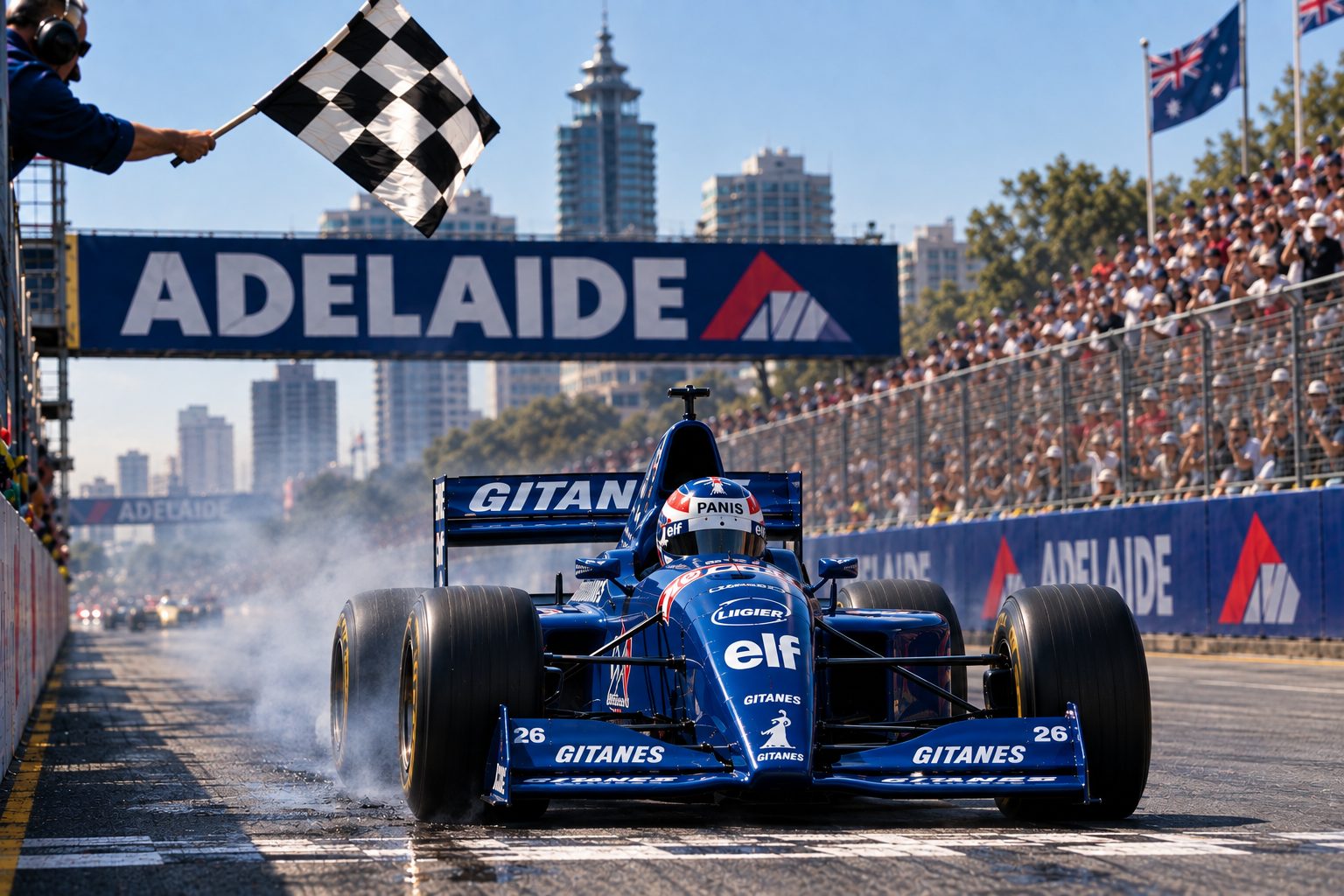
Then came Adelaide, 12 November 1995. It was the last Grand Prix on the street circuit before the race moved to Melbourne, and 210,000 people lined the track. Panis started twelfth. Ahead of him one car after another retired: Coulthard in the pit lane, Schumacher and Alesi after a collision, Herbert with a broken driveshaft. Lap after lap the blue Ligier moved up, until it was running second behind Damon Hill. Shortly before the end the Mugen engine began to lose oil. In a cloud of smoke Panis was lapped by Hill for the second time, but he kept the car in one piece. He finished second, two laps behind the winner. Only eight cars crossed the line that day.
Those six points made his season. Panis finished eighth in the championship with sixteen points, and Ligier came fifth in the constructors' championship. A year later, in the rain at Monaco, he would take the last victory in Ligier's history with its successor, the JS43. Adelaide was the first sign that he had it in him.
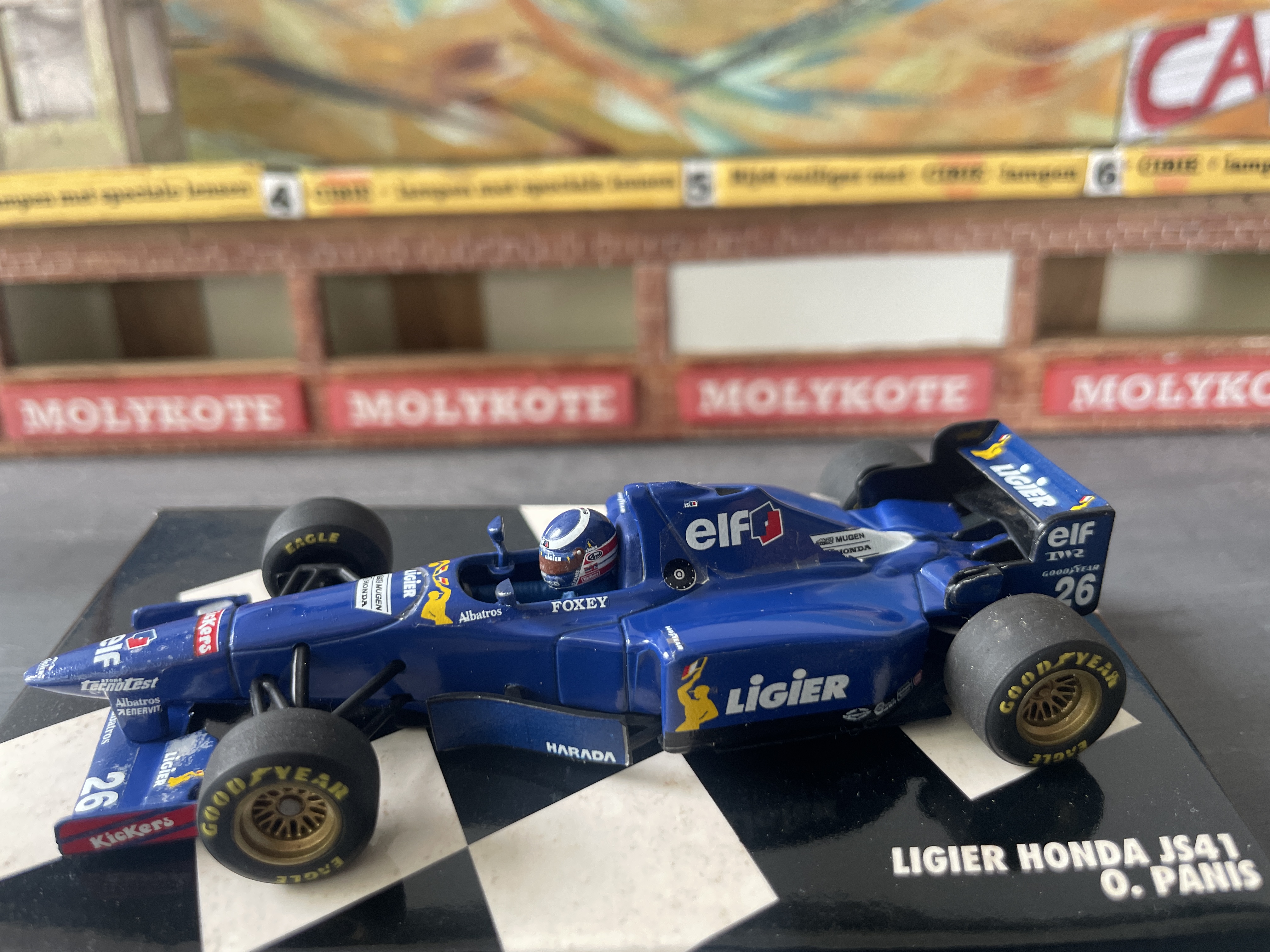
The model in my display cabinet is a Minichamps, with the red Kickers lettering on the front wing, Foxey on the side and the yellow Ligier figure with its raised arm. I found it on Marktplaats. A French car, a Japanese engine, an Italian-British owner — and a Frenchman who got the best out of it.