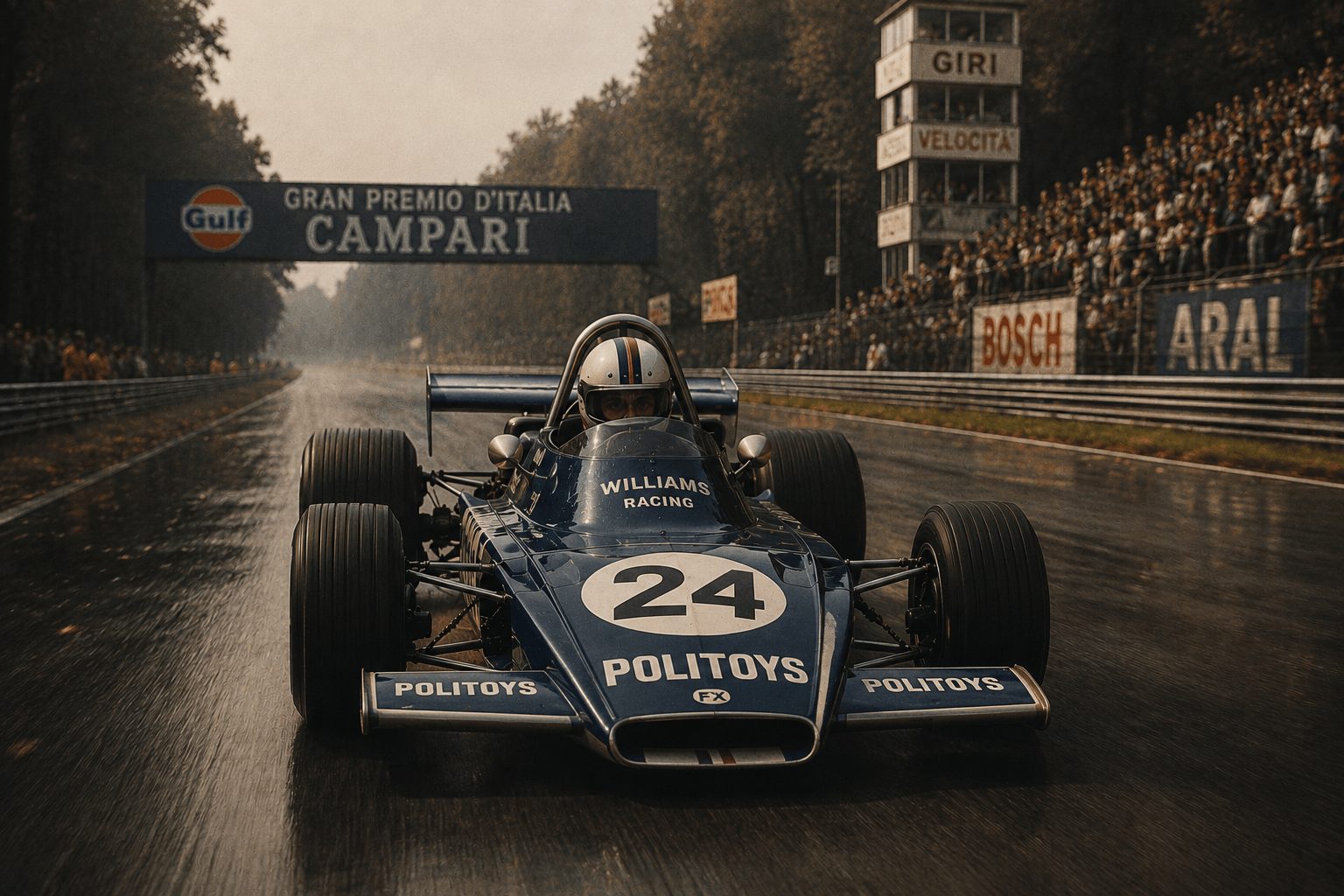

In the early seventies Frank Williams ran a customer team. He bought or hired cars from others — March, among them — and raced them at the back of the field, often on the brink of bankruptcy. What he wanted was something else: to become a constructor, with a car that bore his own name. At the end of 1971 he found the money. The Italian model car and toy maker Politoys put around £40,000 on the table in exchange for title sponsorship. With that, Williams could have a chassis of his own built for the first time.
The design went to Len Bailey, a British engineer who had made his name with the Ford GT40 — the car that had won Le Mans. The FX3 he drew was no revolution, and it did not need to be. It was a neat, conventional monocoque design around the well-proven Cosworth DFV V8 and a Hewland FG400 gearbox: exactly the combination half the field was using. Not an experiment, but a reliable foundation. Williams did not want a miracle car — he wanted a car that was his.
Behind the wheel sat Henri Pescarolo, with number 24 on the nose. The Frenchman — trained as a doctor, already a celebrated endurance driver, who would later win Le Mans four times — was the team's regular driver; that year the team entered as Team Williams Motul. The FX3 was not ready until the British Grand Prix, halfway through the season. At Brands Hatch Pescarolo qualified the brand-new car 26th, more than five seconds off pole. In the race he did not get far: after seven laps something broke in the steering and the car was flung into the barriers. Badly damaged, debut over.
The crew patched the car up again for Monza, but transmission problems arose in free practice and the FX3 was withdrawn. Pescarolo therefore drove the old, familiar March 721 for the rest of the year. The FX3 itself ran only once more in 1972: Chris Amon drove it at the end of the season in the non-championship Victory Race at Brands Hatch. One crash, one withdrawal, one unofficial F1 race — that was all there was in that first year.
And yet it counted. For 1973 the car was rebuilt and renamed the Iso-Marlboro FX3B, with new sponsors and tightened rules on crumple zones. The line that started with that fragile little dark-blue car ran unbroken to the Williams that would later pile up world championships. This model is no monument to a victory. It is the opposite: the beginning, before anyone knew it was a beginning.