
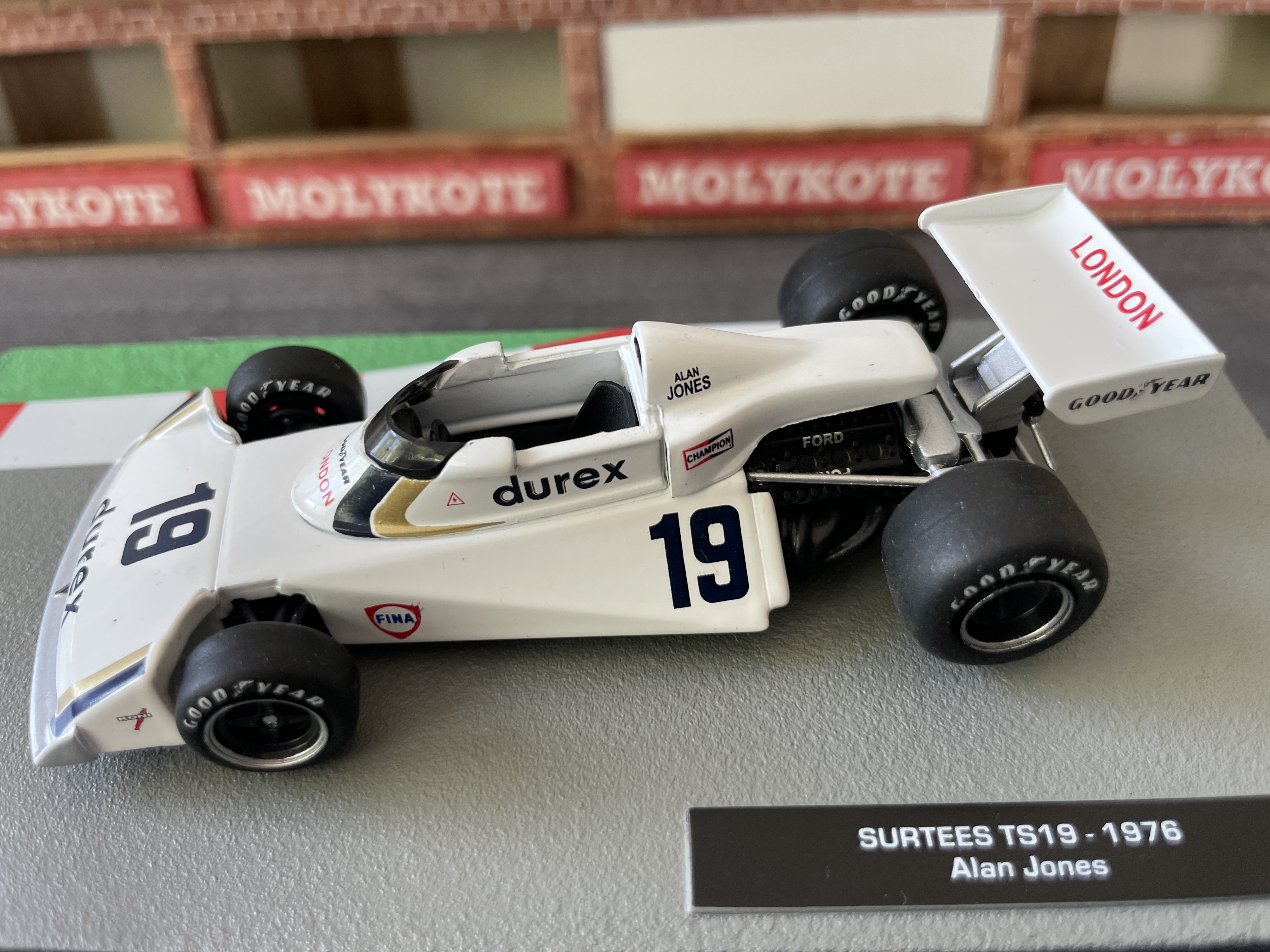
John Surtees — the only man ever to become world champion on both two and four wheels — ran his own F1 team from a workshop in Edenbridge, Kent. At the start of 1976 he had a new chassis ready, the TS19, designed by himself and his regular draughtsman Ken Sears. A light aluminium monocoque, a Cosworth DFV in the back, a Hewland five-speed gearbox in between. Nothing revolutionary, but light and nimble. What was missing was money. Surtees found it — with a sponsor nobody else dared to accept.
The London Rubber Company, maker of Durex condoms, was looking for visibility in a market that had only just opened up: British law had allowed advertising for contraception for a few years, and Formula 1 was the most international stage imaginable. The deal was signed. "DUREX" and "LONDON" appeared on the TS19 in bold letters — across the nose, on the sides, on the rear wing. When the season began in March with the non-championship Race of Champions at Brands Hatch, the BBC announced that the broadcast was cancelled. Officially because of "the unacceptable amount of advertising on the cars". Nobody believed that. It was about Durex.
Alan Jones was an Australian driver whom Surtees had signed for the seat. A year earlier he had made his F1 debut in a second-hand Hesketh for Harry Stiller, and then scored a fifth place at the Nürburgring with Embassy Hill. At Brands Hatch he led the Race of Champions until halfway and finished second behind James Hunt's McLaren. That was enough for Surtees to sign him for the rest of the season — although things soon began to grate between team boss and driver. Surtees was used to having an opinion on everything; Jones was not a man who took orders.
Jones drove fourteen championship races in the TS19. The results were modest: two fifth places (Belgium and Great Britain), two points each time. The highlights of the season came only in October — eighth at Watkins Glen, and fourth at Fuji in a wet race full of drama in which Hunt secured his world title. Seven points in total, fourteenth in the championship. Surtees finished tenth in the constructors' championship. Not a season to launch a driver's career — except that it did. Because in the paddock people had noticed that Jones, with mediocre machinery, consistently got further than expected. A year later he was at Shadow. The year after that at Williams. And in 1980 he became world champion.
This model in my display cabinet shows the TS19 at its most characterful: the light chassis, the narrow nose, the striking white base livery with diagonal red and blue bands, the bold number 19, and — for those who look closely — the Durex and London lettering on the rear wing. On the side "Alan Jones" is written by hand. The Goodyear tyres sit snugly on the stand, and the Fina sticker is above the front wheel. It is not a winning car. It is a season few people can ignore — not because of the results, but because of the stir the car caused in the press. And with a driver, what is more, who would make his mark a few years later.