
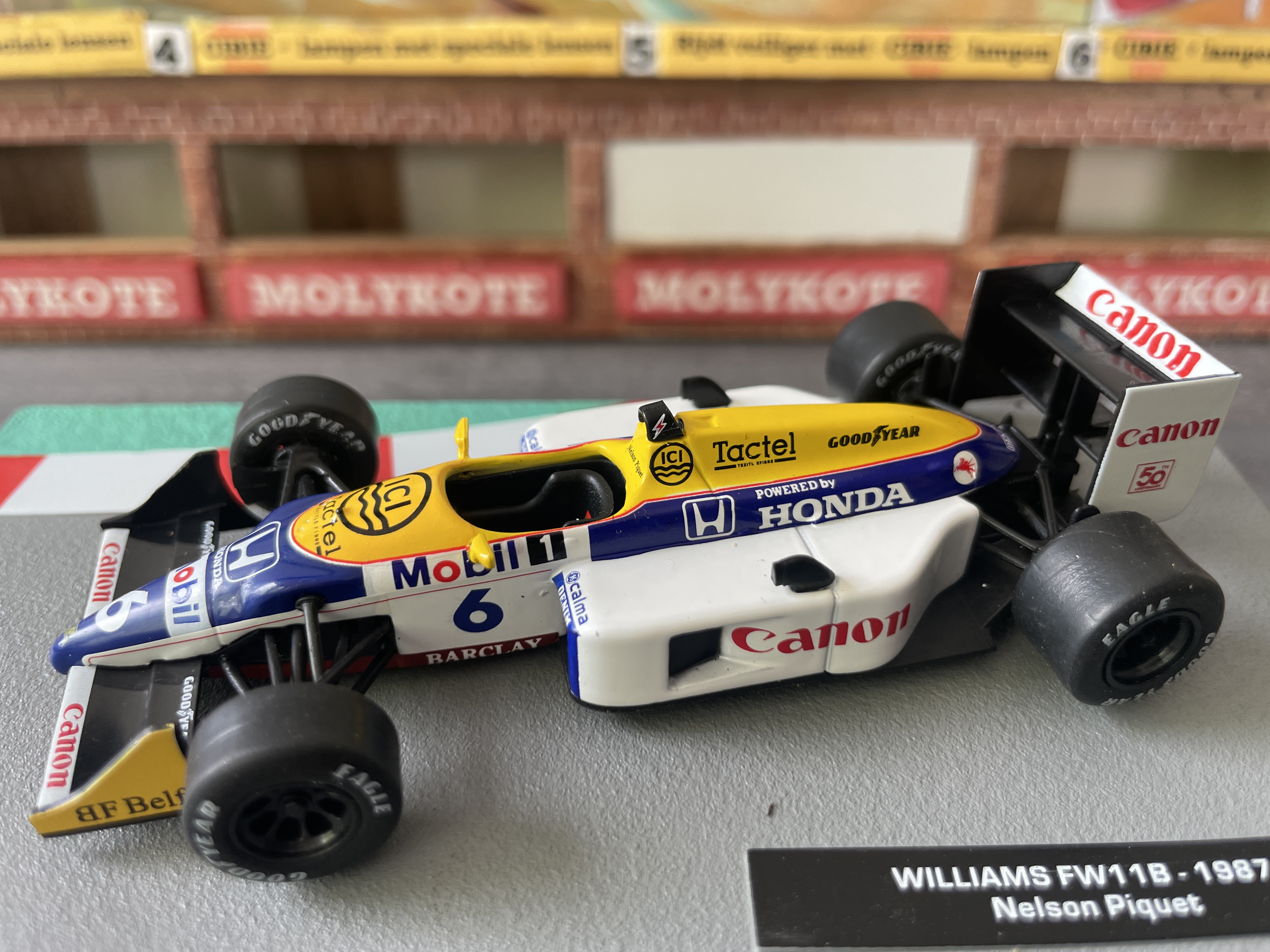
In 1987 the Williams FW11B was simply the car to beat. It was the further developed version of the FW11, with which Williams-Honda had won the constructors' title the year before but had thrown away the drivers' title at the very last moment. For 1987 Patrick Head and Frank Dernie refined the chassis around Honda's RA167E — a 1.5-litre V6 turbo that in qualifying trim could deliver well over a thousand horsepower! The team won nine of the sixteen races and took its second consecutive constructors' title with ease.
Within that team the real battle raged. Nigel Mansell was the spectacular attacker, the man of pole times and daring overtakes — he won six Grands Prix. Nelson Piquet was his opposite: calculating, patient, a master of what he himself called "percentage driving". Where Mansell drove on the limit, Piquet collected podium finishes. From Detroit to Portugal he was on the rostrum race after race — mostly in second place, just enough to bring home the title.
Hardly anyone knew how much effort those second places cost Piquet. During practice for the San Marino Grand Prix he had a heavy crash at the notorious Tamburello corner at Imola. He was not allowed to start. By his own account the impact cost him some eighty per cent of his depth perception; throughout the season he secretly visited a hospital in Milan every two weeks, afraid the team would take him out of the car if they knew the truth. Still he kept on scoring.
His three wins came at the moments that mattered. In Germany and Hungary he profited from Mansell's bad luck; in Italy he showed his class. Monza saw the debut of Williams' new reactive — active — suspension. Piquet took pole, could run with less wing and was a good five miles per hour faster than Mansell on the straights. When Senna ran wide at the Parabolica eight laps from the end, the win was his.
The decider came in Japan. Mansell crashed in practice at Suzuka and was injured — which mathematically settled the title in Piquet's favour, with two races still to go. Piquet, still recovering from the Imola crash, gave Suzuka and Adelaide a miss. His third world title was a fact, after 1981 and 1983.
It was also the end of an era. During the Italian Grand Prix Honda announced that from 1988 it would supply its turbo engines to McLaren and Lotus, leaving Williams after four years. This model in my display cabinet wears the Canon livery with the broad number 6 — quiet evidence of a championship won with the head, not with bravado.