
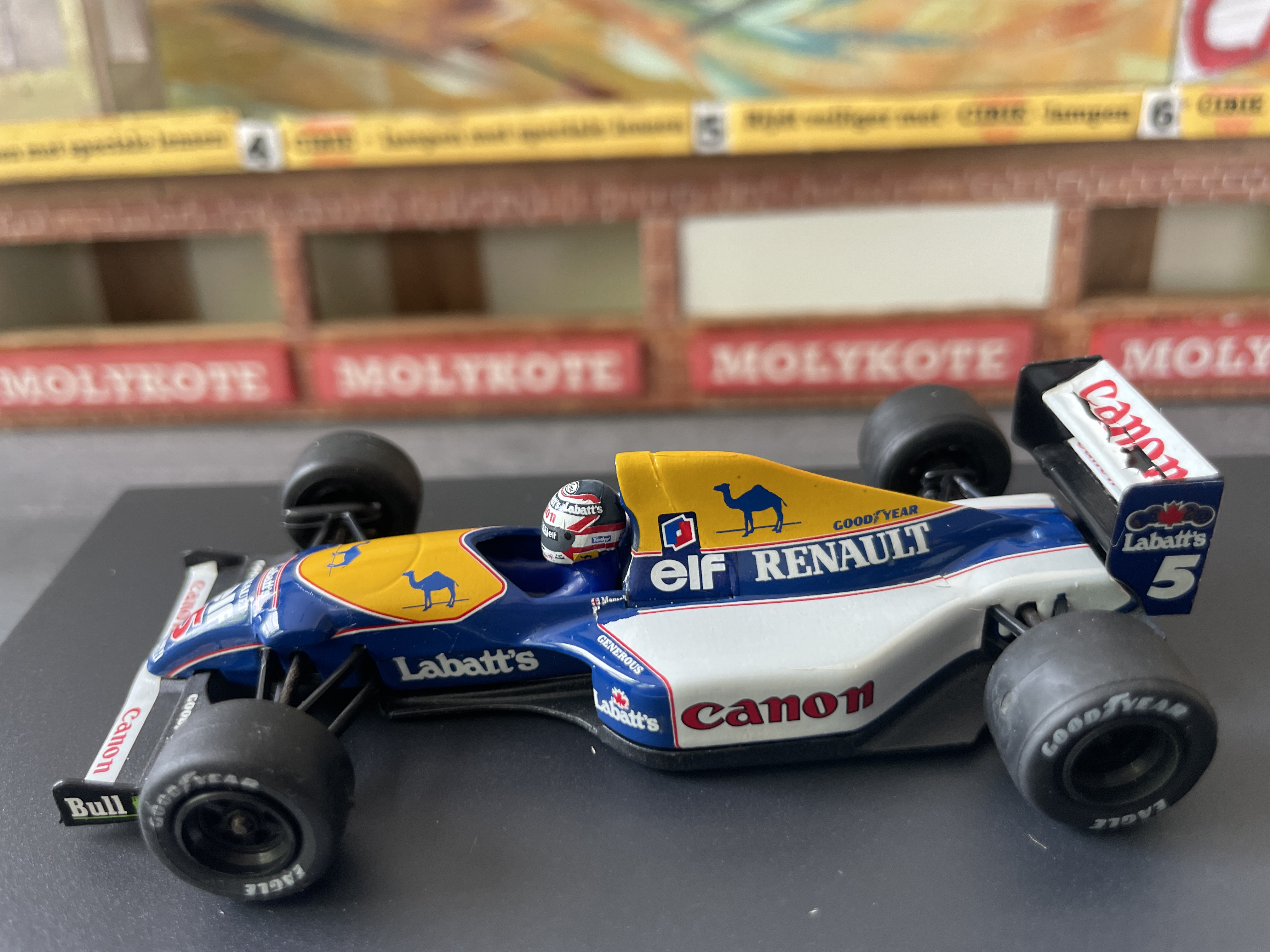
The FW14B was not a new car, but the perfection of an existing one. Adrian Newey had designed the FW14 a year earlier, under the technical direction of Patrick Head, and even then the car was aerodynamically brilliant. What set it in a class of its own for 1992 was the electronics: fully active suspension — front and rear — that kept the car at the ideal ride height in all conditions, combined with a semi-automatic six-speed gearbox, traction control and, for a short while, even ABS. While drivers elsewhere were still wrestling with their machines, Mansell could concentrate on pure driving.
Under the engine cover sat the Renault RS3C, a 3.5-litre V10 whose development was led by Bernard Dudot. Powerful, reliable and smooth — the perfect partner for Newey's chassis. In the blue, yellow and white Camel livery, with Canon on the flanks and Labatt's on the nose, the FW14B became the most recognisable silhouette of early-nineties F1. With the red 5 on the nose.
The season became a demonstration. Mansell won the first five races in a row — Kyalami, Mexico City, Interlagos, Barcelona, Imola — a record. That year he took fourteen poles from sixteen races, another record. Whenever the opposition hoped for a weak moment, it simply never came. On 16 August, in Hungary, it was all over: second place behind Senna was enough to become world champion with five races still to go. The first British title since James Hunt in 1976 — and at the same time the constructors' title for Williams-Renault.
By the end he had nine wins to his name — the first time ever a driver had won nine in a single season — and 108 points. Yet the year ended on a sour note: negotiations with the team over his salary and the arrival of Alain Prost broke down, and the newly crowned champion left for American IndyCar racing — which, incidentally, he would win straight away in his debut year. His farewell to Formula 1 came at his peak.
This 1:43 model in my display cabinet wears the complete Camel-Canon-Labatt's livery, the broad red number 5 and the tall rear wing with the red Labatt's maple leaf. It is the car as Mansell drove it that year: technically superior, visually iconic, and inseparable from the only world title of one of the most popular drivers the sport has ever known.