The 1993 season began with a curiosity: there was no reigning world champion on the grid. Nigel Mansell had won the title at the end of 1992 and then left for the American IndyCar series. As a result, racing number 1 went unissued, and Williams — as winner of the constructors' championship — was allocated numbers 0 and 2. Damon Hill, in his first full season with a top team, thus drove with a zero on the nose. Alain Prost, back after a year without a seat, got the two.
Prost had made good use of that sabbatical year. From the sidelines he watched Williams-Renault outclass everyone, and as early as the second race of 1992 his contract for the following two years was ready. It contained a clause that showed Ayrton Senna the door: as long as Prost drove there, Senna would not get in. Senna then publicly called him a coward. Even by their standards, it was a frosty way to begin a season.
The car at the centre of it all was designed by Adrian Newey under technical director Patrick Head. Unlike the FW14B — a good car into which active suspension had been built afterwards — the FW15C was designed around that system from the very first sheet of paper. The hydropneumatic suspension kept the car at exactly the right ride height in all conditions; on top of that it had traction control, ABS, a semi-automatic gearbox and a push-to-pass button. The Renault RS5, a 67-degree 3.5-litre V10, produced between 760 and 780 hp at 13,800 rpm. The whole package weighed 505 kilos. Anyone standing next to a car like that in 1993 was looking at the future.
On the track the difference was just as large. Prost won seven of the first ten races and over the whole season took thirteen pole positions out of sixteen. The exceptions were almost as famous as the wins: in Brazil he slid off the track in pouring rain and took Christian Fittipaldi with him; at Donington Park Senna drove the race of his life in an inferior McLaren and Prost finished third after an afternoon full of pit stops; in Hungary his engine stalled on the formation lap, he had to start from the back, and then his rear wing broke, which finally settled the weekend. Twelfth, seven laps down — in the fastest car in the field.
On Friday 24 September, in the run-up to Estoril, Prost announced that he would retire at the end of the year. It was part of a deal: he could block Senna's arrival in 1993, but not in 1994. In return for his departure, Williams paid him his salary for the year he would no longer race. Two days later he drove to second place behind Michael Schumacher, and that was enough. Four world titles, with two races to go, twenty-six points ahead of Senna. In Adelaide, his final Grand Prix, he stood next to the man he had been fighting for ten years — who embraced him on the podium.
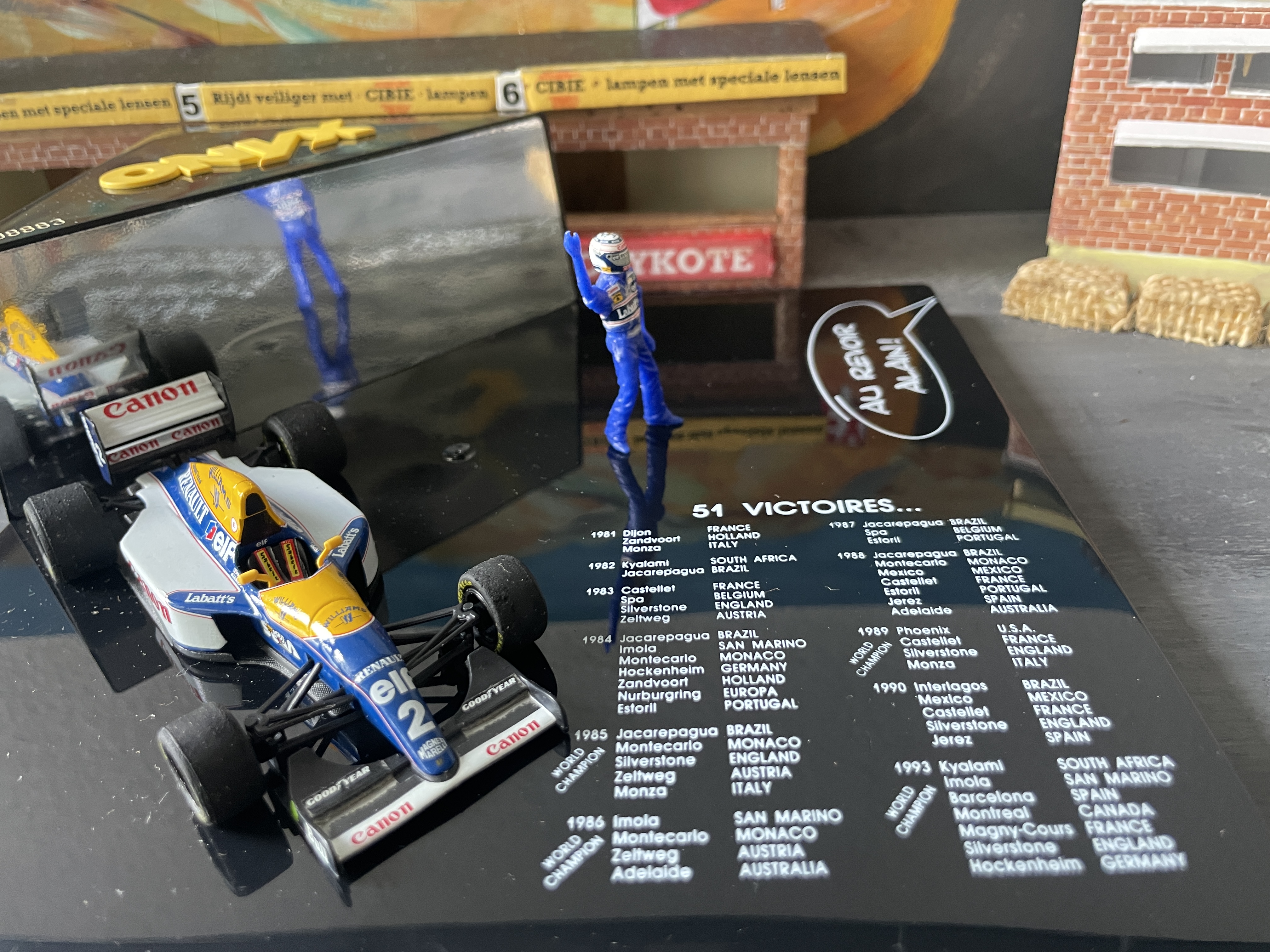
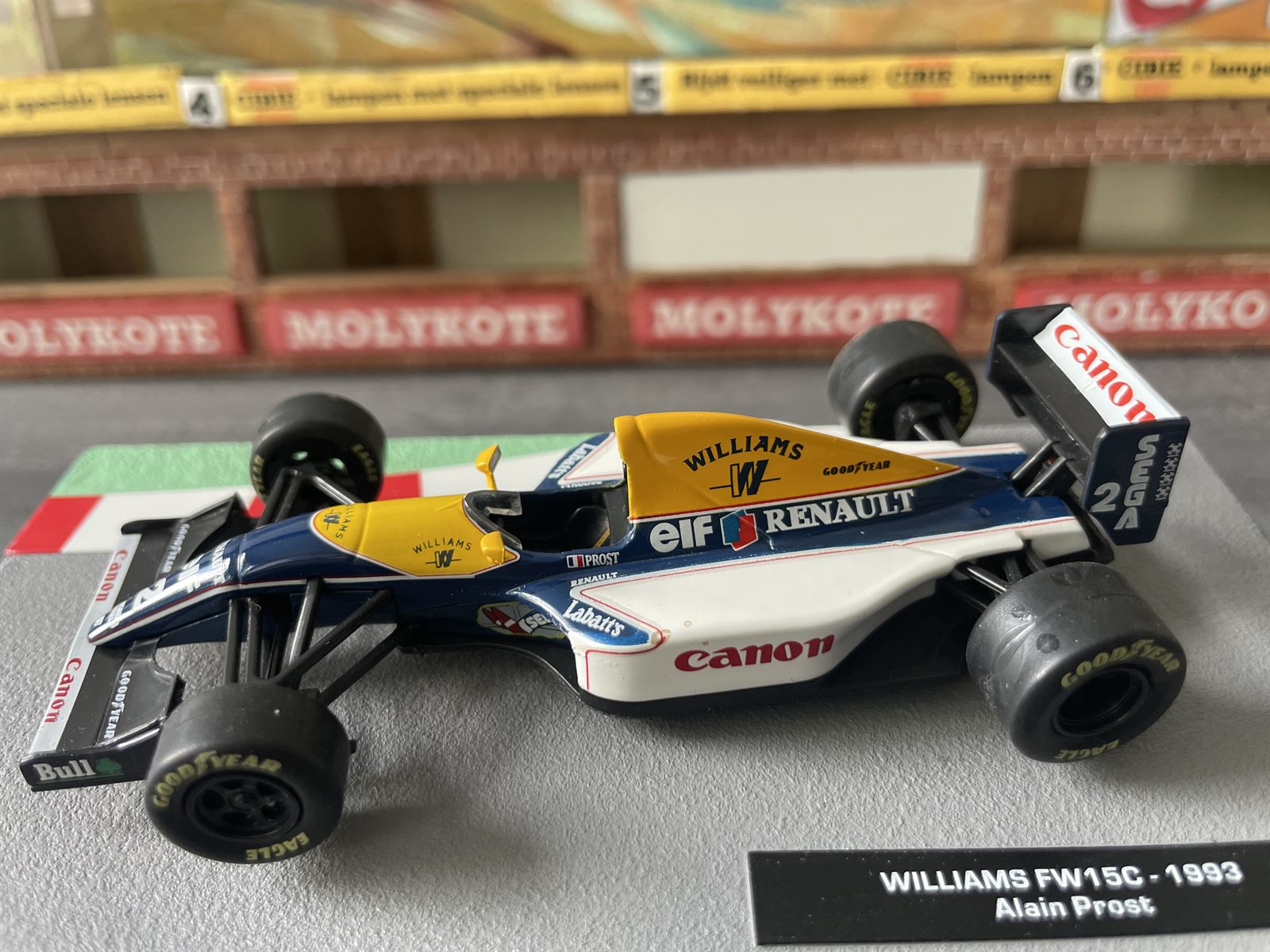
What happened next is part of the story too: for 1994 the FIA banned almost all the electronic aids that made the FW15C so special. Active suspension, traction control, ABS — all gone. That makes this car the end point of an era that nobody has been allowed to repeat since. The model in my display cabinet wears the dark blue and white with the yellow nose of Canon and Renault, the Sega wing and the number 2. It is the car of a champion who knew exactly when to stop.