
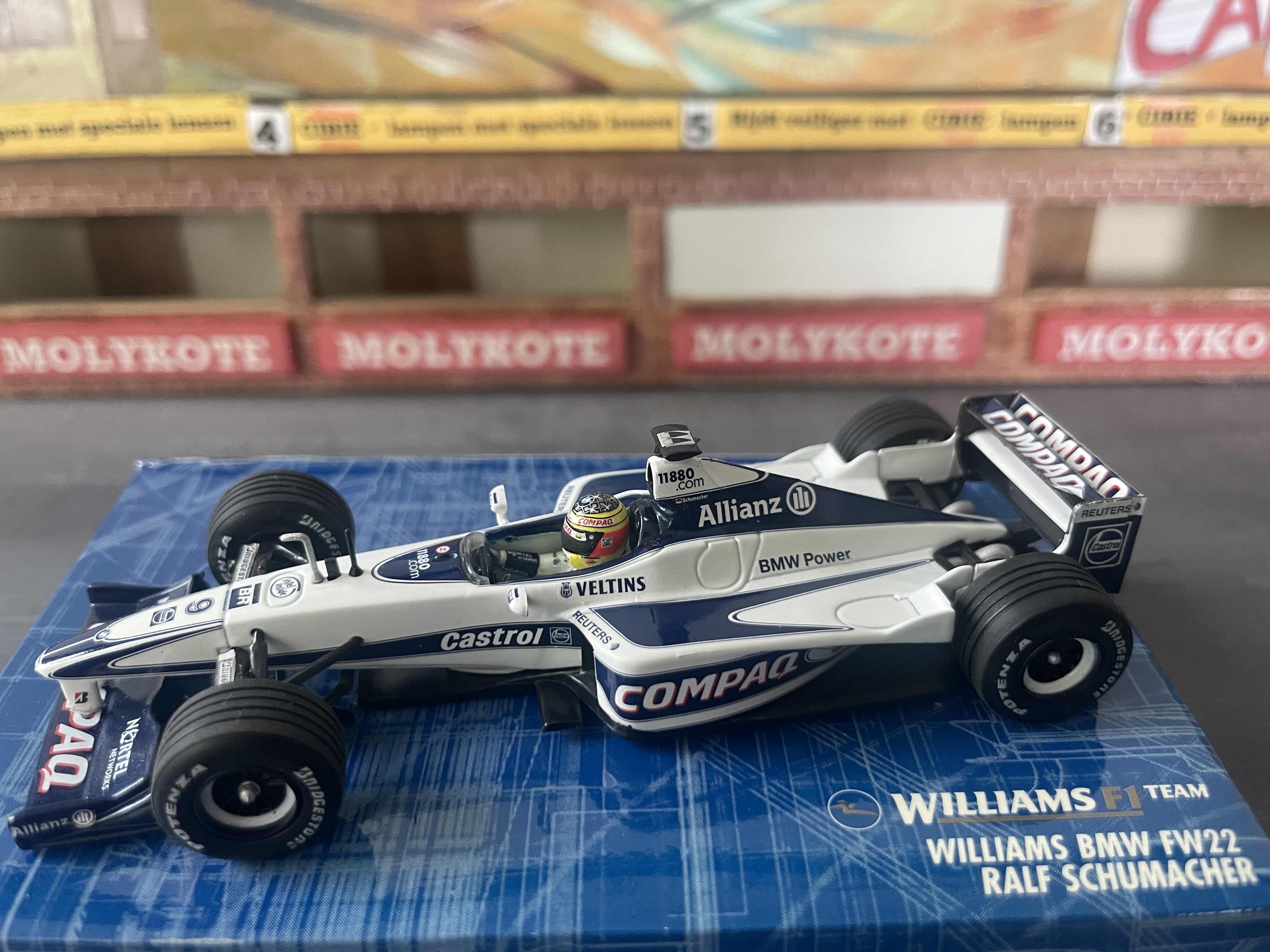
Williams had won the world title in 1997 and then fallen hard. Renault left as works supplier, and for two seasons the team from Grove raced with customer engines that carried a different name on the cam covers — Mecachrome, then Supertec. They were decent engines, but without a future. In 1998 and 1999 Williams did not win a single race. For a team used to championships, that felt like standing still.
The way out had been signed as early as 1997 and only became visible in 2000: BMW would return to Formula 1 as a works supplier, exclusively for Williams. It was the first time since 1987 that a fully factory-backed BMW engine sat in a Formula 1 car. Munich had spent two years working on it on the test bench. The E41/4 was a three-litre, 72-degree V10, good for around 810 hp at 17,500 rpm — impressive on paper, but also longer and heavier than the Supertec it replaced. Patrick Head, Gavin Fisher and Geoff Willis had to adapt the FW22 to it: the wheelbase was lengthened by seven centimetres and the sidepods were made taller, simply because the new engine needed more cooling than the old one.
The driver pairing was an odd mix of experience and youth. Ralf Schumacher was starting his second year at Williams and, at twenty-four, suddenly found himself team leader. Alongside him came Jenson Button, twenty years old and a rookie, who took the place of Alex Zanardi — sent away after one difficult season. Hardly anyone expected anything from this first year. It was meant as a learning year: engine and team had to get used to each other.
Melbourne, 12 March 2000, turned all that on its head straight away. Ralf qualified eleventh, more than a second and a half behind Mika Häkkinen's pole. But it became a race of attrition. Häkkinen's engine failed on lap eighteen, David Coulthard's already on lap eleven; Frentzen and Trulli did not make it to the end either. Nine cars finished. Ralf Schumacher was one of them, and he was third. BMW had a podium at its first Grand Prix in thirteen years. Two weeks later Button scored his first point in Brazil and became the youngest points scorer in the history of the sport.
The rest of the year was less rosy. Ralf took two more third places — Spa and Monza, both circuits where the BMW engine could use its power — but the second half of the season was plagued by retirements: he failed to finish five of the last six races. Twenty-four points, fifth in the world championship. Together with Button's twelve points that made thirty-six for the team and third place in the constructors' championship, behind a dominant Ferrari and McLaren. Exactly what a learning year should deliver, and more than anyone had asked for beforehand.
The model in my display cabinet wears the Compaq blue and white that marked those first BMW years, with number 9 and the full sponsor line-up of that season: Castrol, Allianz, Veltins, Reuters, Nortel Networks, 11880.com and the blue-and-white BMW roundel on the nose. On the sidepod, small and businesslike, it says "BMW Power". In 2000 that was still a promise.