Amédée Gordini was born in Italy and built a reputation in France that was bigger than his workshop. They called him le Sorcier, the sorcerer, because he could extract power from modest production engines that the manufacturers themselves could not come close to. His équipe raced on a fraction of the budget of the big names: where Ferrari and Maserati arrived at a Grand Prix with factory money, factory staff and a row of spare cars, Gordini turned up with a handful of mechanics and equipment that had already done a season's service. That the team managed to keep going in the world championship for years says more about ingenuity than about resources.
The Type 32 was his answer to the 2.5-litre formula. Drawn in 1955, built in 1956, with a straight-eight producing around 250 hp at 7,500 rpm — on paper enough to compete. The chassis was a tubular frame, and the car had disc brakes with extra cooling slots, independent suspension and a five-speed gearbox. The only thing was: it weighed around 700 kilos, and in this company that was simply too much. Two were built. Both, as was later soberly recorded, were no match for the competition. The car made its debut at Monza at the end of 1955 and had its only full season in 1956.
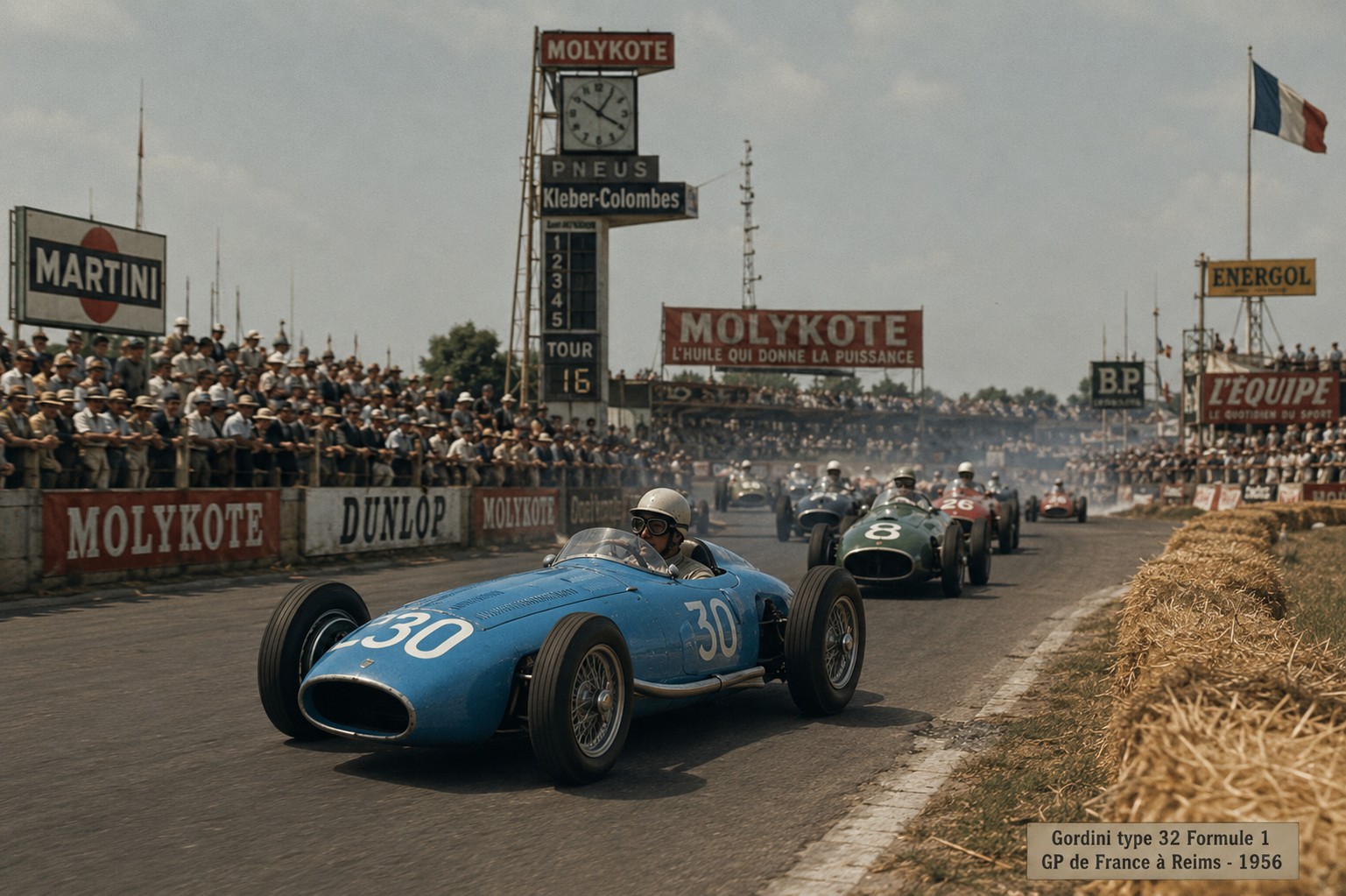
On 1 July 1956 it lined up at Reims, the fastest circuit of the year, among the cornfields of Champagne. Fangio took pole in the Ferrari with 2:23.3. Robert Manzon put the Gordini on 2:36.0 — almost thirteen seconds a lap slower, good for fifteenth on the grid. The race ran over 61 laps and was won by Peter Collins, who crossed the line after two and a half hours with three tenths in hand over Castellotti. Manzon brought it home in ninth, five laps down. In the sister car, number 32, Hermano da Silva Ramos finished eighth. Given the circumstances, it was exactly what the car had in it.
By then Manzon was already a veteran. Born in Marseille in 1917, he started out as a mechanic, raced a Cisitalia after the war, and from 1948 was attached to Gordini. In that blue he took his two podium finishes — in Belgium in 1952 and in France in 1954. Twenty-six starts, sixteen points, and a habit of bringing home a car that was not really capable of it. 1956 was his last season: retirements at the Nürburgring and Monza, ninth places at Reims and Silverstone. When Gordini withdrew from Formula 1 at the end of the year, Manzon stopped too.
In my register there is a short note next to this model: that this was in fact a Formula 2 car, from the time when Grands Prix were run with F2 machinery. In 1952 and 1953 the world championship was run to Formula 2 regulations, and it was precisely in those years that Gordini achieved his best results — Manzon's podium in Belgium came from exactly that period. The Type 32 itself was built to the 2.5-litre rules that came afterwards, but it comes from the same small workshop, with the same way of doing things: draw it yourself, build it yourself and hope it is enough.
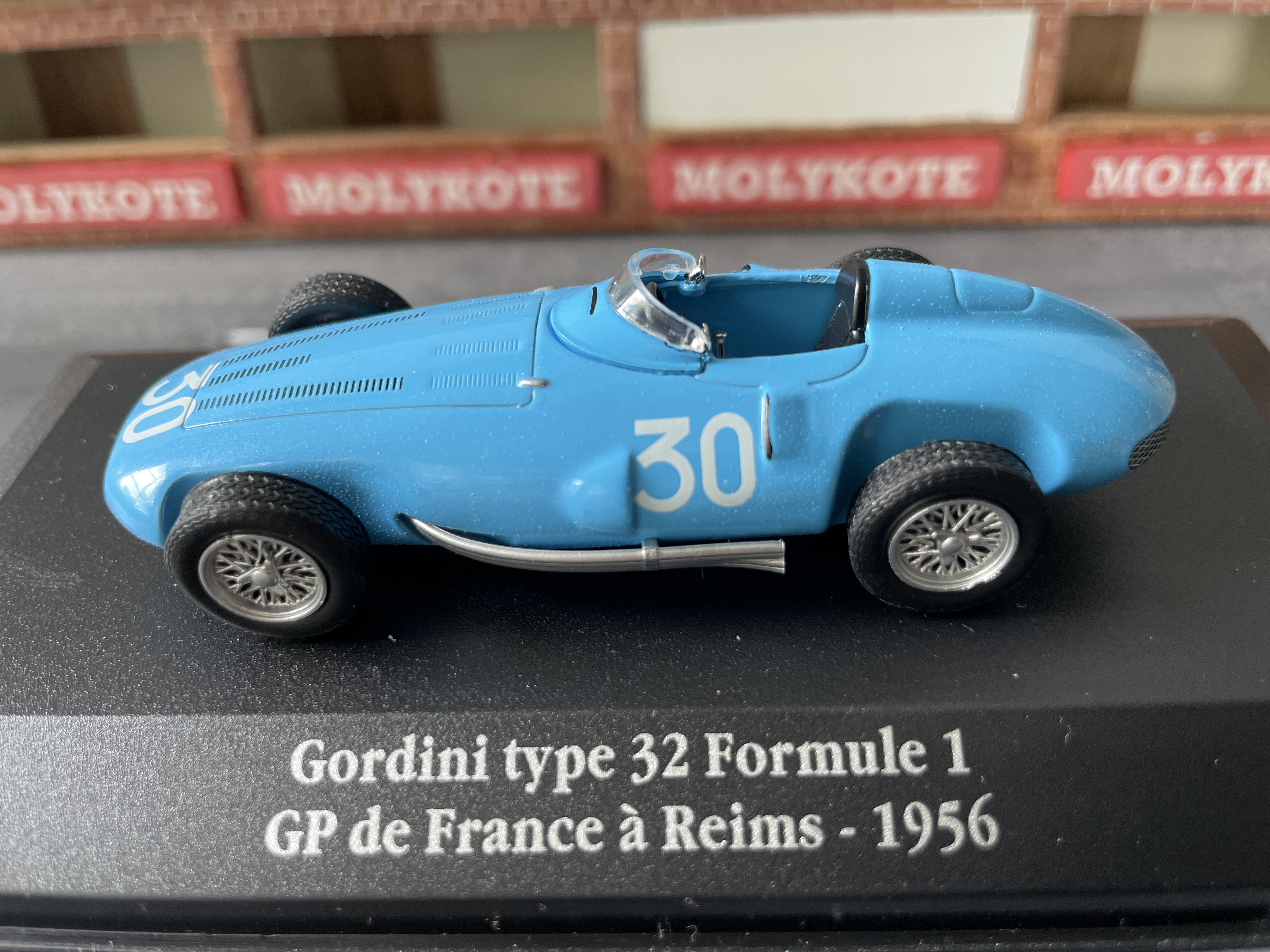
The model in the display cabinet is that Reims car: French racing blue, number 30 on the nose, wire-spoked wheels and the long cigar shape that was already almost out of date in 1956. I bought it in 2024 at the Namac fair from Ed Models Cars, for just five euros. Collecting does not always have to be expensive. A fine example, in memory of the end of a French team, the last season of a driver and the last design of a man who spent his whole life getting more out of less.