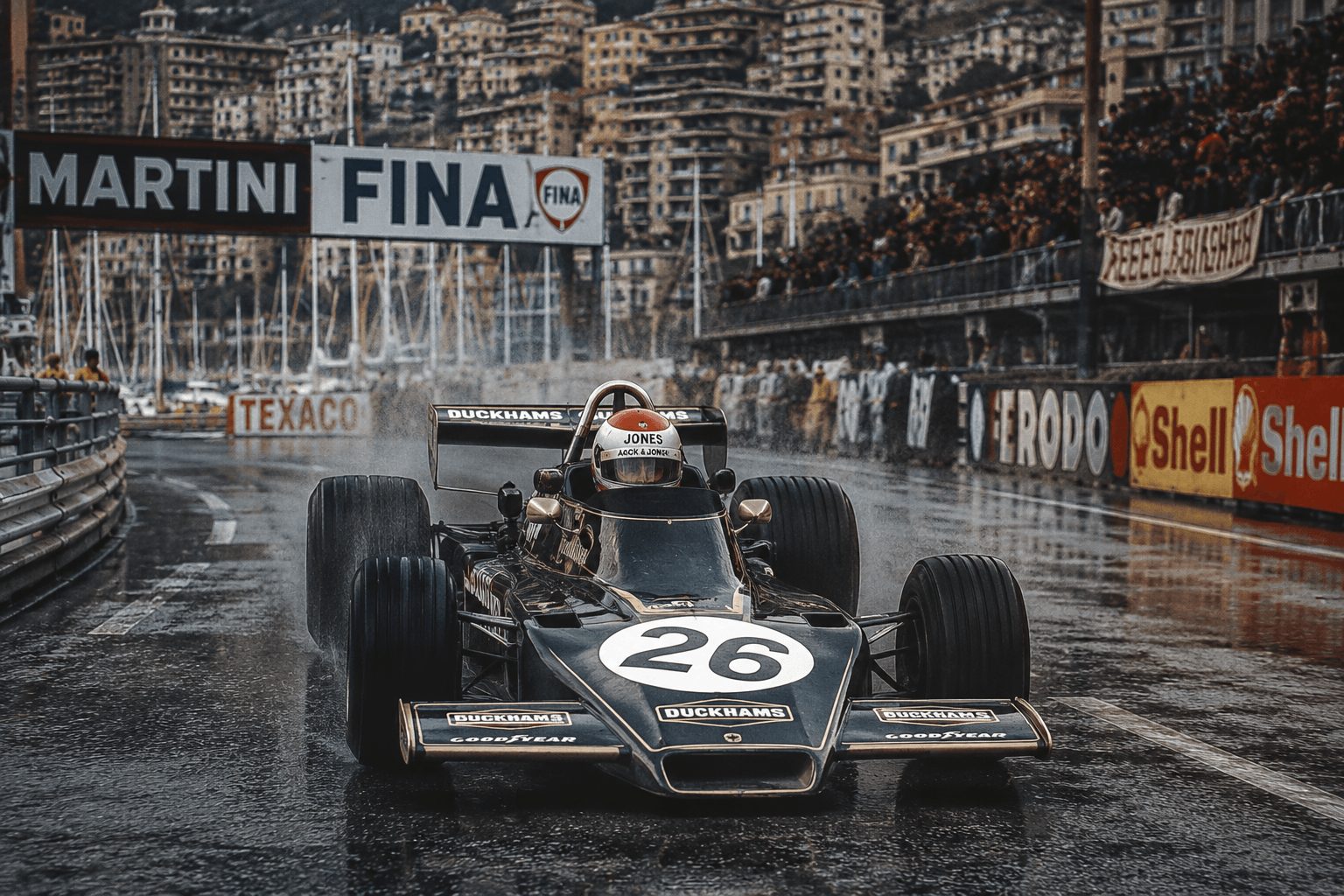

In 1975 Hesketh Racing was still the self-satisfied, lilac-tinted clown of the F1 paddock — Lord Alexander Hesketh's private team, which raced without sponsor logos and had James Hunt driving a 308B designed by the young engineer Harvey Postlethwaite. What is less well known: chassis 308-1, the first of that generation, was soon sold. The new owner was Harry Stiller, a Briton who had made his fortune in property and bought his own team to give Alan Jones — a 28-year-old Australian with no F1 experience — a chance. The car was painted in the blue and red of Custom Made, a British menswear shop, and given race number 26.
Jones's first Grand Prix was Spain, on the Montjuïc circuit in Barcelona — a very black day in F1 history. The barriers were poorly fixed and the drivers had threatened to boycott. On lap 26 Rolf Stommelen's car flew over the barrier into the crowd. Five spectators died. The race was stopped. Jones saw it from a distance. Three weeks later he was on the grid at Monaco — the sea to his left, Princess Caroline in the royal box and the whole paddock still badly shaken by Stommelen's crash. He qualified eighteenth. The very last place on the grid.
That Sunday the heavens opened. Monaco was wet, but during the race it dried out — Niki Lauda led from pole and held the lead for eighty minutes. Jones, somewhere in the pack, fought his way forward a little. On lap 61 — fifteen from the end — he heard something odd from the car. A wheel had come loose. He let it roll to a safe stop. Lauda won by 2.78 seconds from Fittipaldi.
It was, looking back, an unfortunately short chapter. Stiller stopped after four races — Spain, Monaco, Belgium, Sweden — and moved abroad for personal reasons. Jones was immediately picked up by Graham Hill's Embassy Hill team, which needed a replacement after Stommelen's injury. There he scored a fifth place at the Nürburgring. A year later he drove for Surtees, in 1977 for Shadow, and in 1978 for the team with which he would win the world title in 1980: Williams. But with this car, this chassis and on this circuit — that is where it all began.
This model in my display cabinet wears the Custom Made colours with the Goodyear and Duckhams decals of that season, number 26 on the nose and the BRG-tinted Hesketh nose section. The rear wing stands steeply upright — Monaco set-up. It belongs to what is really one of the most underrated drivers of the 1970s.