
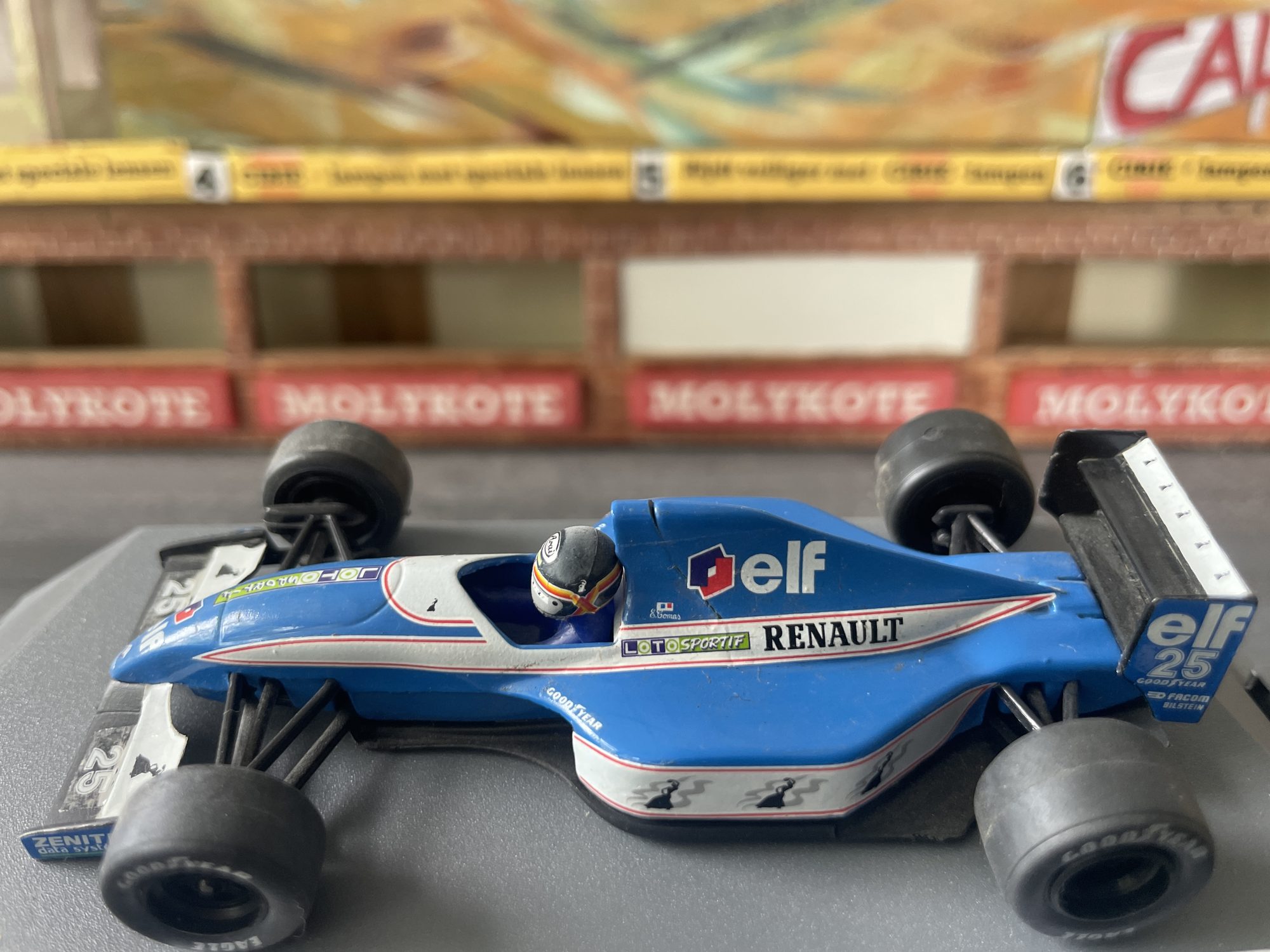
At the start of 1992 Ligier had, on paper, everything it needed to be competitive again at last. The team from Magny-Cours was given the same Renault V10 as Williams, the engine with which Nigel Mansell would win the championship that year. Frank Dernie designed the car and Gérard Ducarouge was technical director. Guy Ligier was still in charge, but he was already looking for a buyer. At the end of that year Cyril de Rouvre would take over the team.
Before the season a rather special guest came by. Alain Prost had been sacked by Ferrari and was facing a year without a drive. He tested the JS37 several times, wearing the helmet of Boutsen's teammate Érik Comas, and set fast times. Prost wanted not only to drive but also to become a co-owner. Just before the first race in South Africa the deal fell through. Comas kept his seat and Prost stayed at home that year.
Boutsen struggled with the car, and both qualified and raced less well than his teammate Comas. Only in the last race of the season did Boutsen score, taking 2 points by finishing fifth in Adelaide.
Then Spa, at the end of August. In practice his teammate Comas crashed heavily at Blanchimont, one of the fastest corners on the circuit. He was unconscious and his foot was still on the throttle, the engine screaming on. Ayrton Senna came by, pulled his McLaren over and ran to the Ligier. He switched off the engine and held Comas's head still until the doctors arrived. To this day Comas says Senna saved his life. He was not allowed to take part in the race. Two weeks later, at Monza, he was back on the grid.
The model in my display cabinet is an Onyx, in Ligier blue, without the Gitanes lettering of the real car. There is a small puzzle to it. The nose and rear wing carry number 25, but next to the cockpit is Comas's name, while the helmet is definitely Boutsen's. In 1992 number 25 was Boutsen's car and number 26 was Comas's. That is why this story has really become a combination of two drivers.