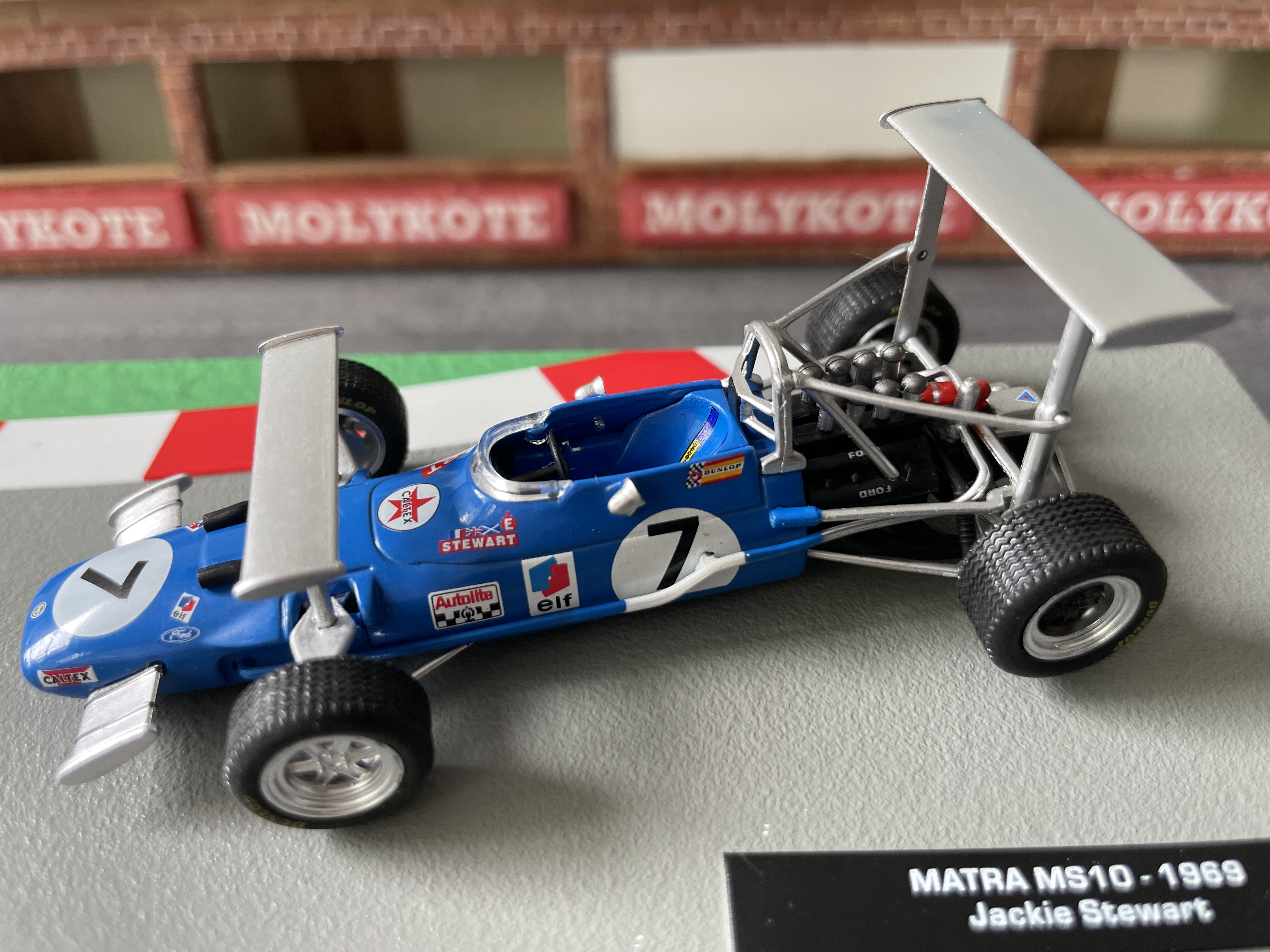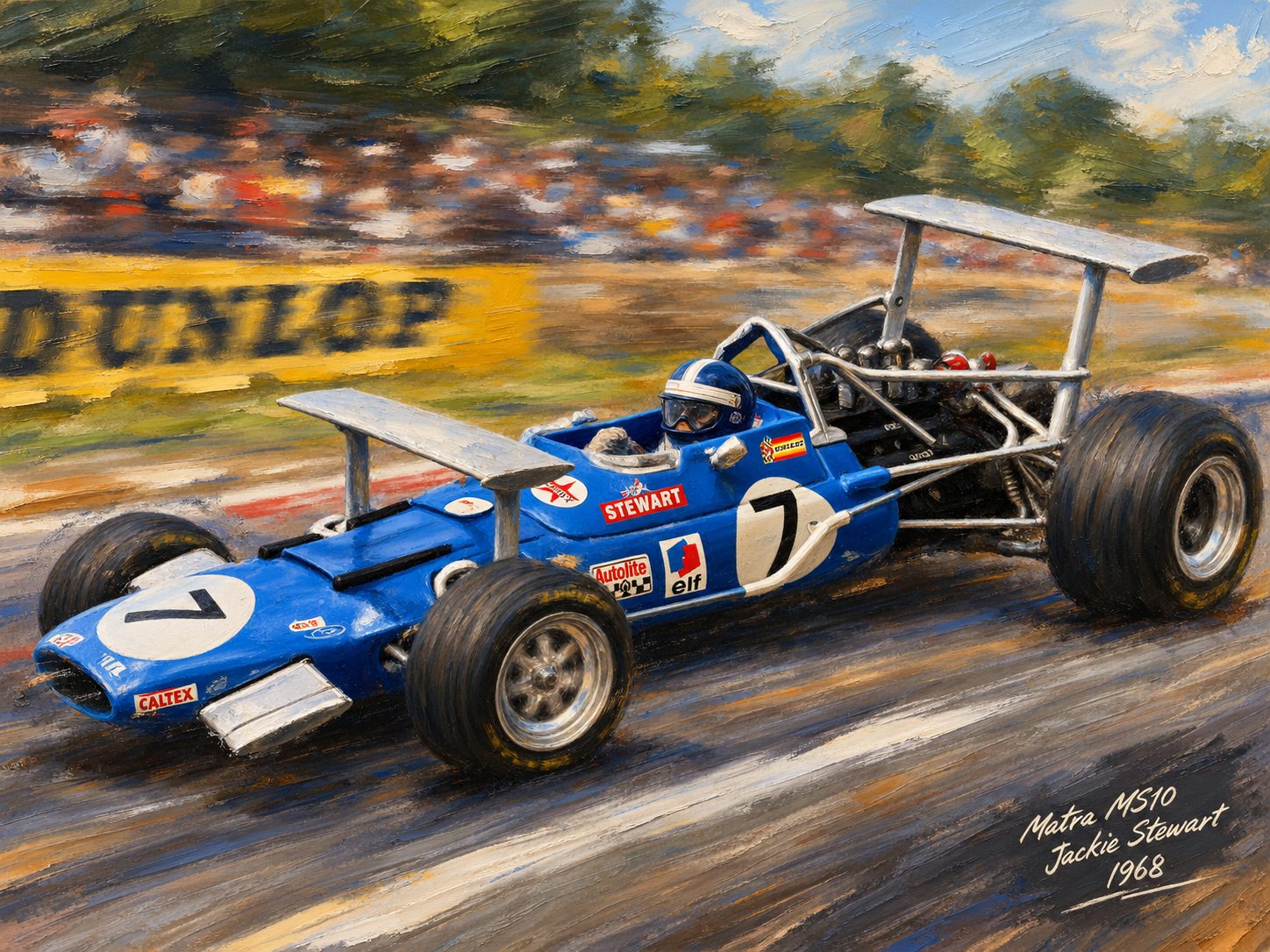
The Matra MS10 is a car with three passports. The chassis came from Vélizy, from the drawing boards of Matra — a French company that built not only racing cars but also missiles and guided weapons. The engine came from Northampton: the Ford Cosworth DFV, the three-litre V8 that would dominate Formula 1 from 1967 onwards. And the man who brought the two together was an English timber merchant with a nose for talent: Ken Tyrrell, who entered his team under the name Matra International.
At Matra, designer Bernard Boyer had borrowed a trick from the aviation industry. Where most teams hung their fuel in separate tanks inside the chassis, Boyer made the tanks themselves load-bearing — part of the monocoque. That saved around fifteen kilos on a car of 540 kilos, and made the MS10 one of the lightest cars in the field. The FIA would ban the construction for 1970.
In 1968 it became Stewart's car. He had come from BRM, where three years of talent had leaked away into unreliable engineering, and he won three Grands Prix with the MS10. The most famous is the one at the Nürburgring: fog, pouring rain, visibility at times no more than a few metres, Stewart with a broken wrist in a plastic splint — and after 14 laps a lead of four minutes and three seconds over Graham Hill. To this day it counts as one of the most remarkable drives in the history of the sport.
When the field lined up at Kyalami on 1 March 1969 for the opening race, the MS10 was already almost an old car. The new MS80 was being built. But Tyrrell had used the winter break to test fifteen different Dunlop rubber compounds at Kyalami, and that homework paid off. Stewart qualified fourth, four tenths behind Jack Brabham's pole, was in the lead after one lap and did not give it up for eighty laps. He won by eighteen seconds from Graham Hill and set the fastest lap along the way.
It was the MS10's last victory. From Spain onwards Stewart drove the MS80, won five more races with it and became world champion for the first time; Matra took the constructors' title. The car in my display cabinet still carries the tall, thin wings on 'stilts' that were banned that season, shortly before and after Monaco — a snapshot of a Formula 1 that within a single year had become a different sport.