
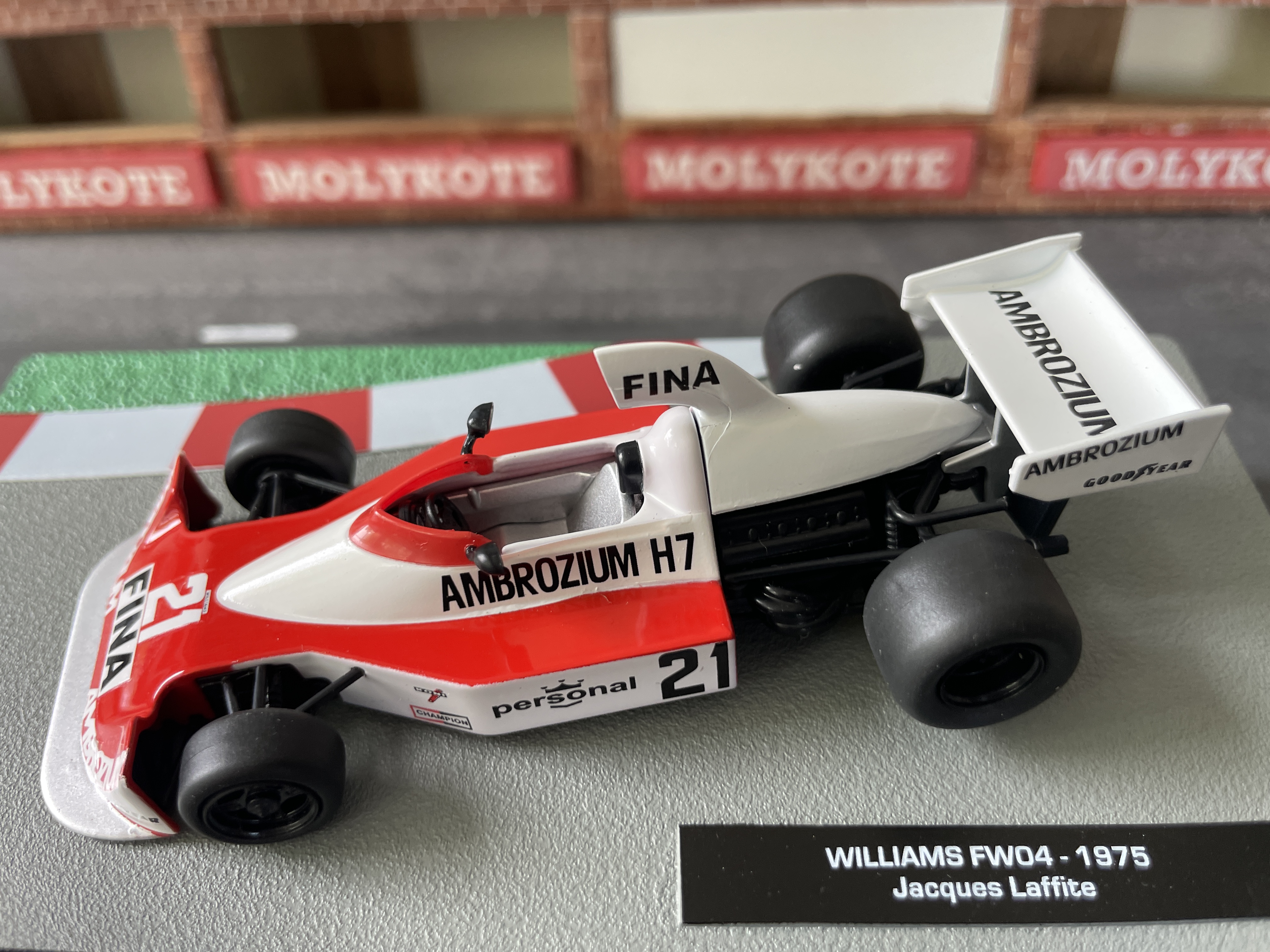
At the start of 1975 Frank Williams was not a name that made anyone look up. His team, Frank Williams Racing Cars, had been around for a few seasons, but had never won anything and was almost permanently short of money. The story goes that the team bought used tyres and second-hand parts from its richer rivals just to get the cars onto the grid at all. The nose of the new FW04 literally came from a Hesketh 308. And yet that year Williams built its first chassis entirely of its own — the FW04, designed by former McLaren man Ray Stokoe. Narrower and more streamlined than its predecessor, and powered by the reliable Ford Cosworth DFV.
The car was not ready at the start of the season; it only made its debut at the Spanish Grand Prix at Montjuïc. What makes the FW04 really special cannot be seen from the outside. For 1975 a young engineer joined the team: Patrick Head. He immediately reworked the car's cooling and fuel supply, making it noticeably faster. It may be a footnote in the history books, but it was also the beginning of something wonderful: the partnership between Frank Williams and Patrick Head. Years later it would grow into one of the most successful partnerships Formula 1 has ever known. In this meagre, half-borrowed car lies the seed of a dynasty.
Behind the wheel sat Jacques Laffite, number 21, in the colours of FINA and the Swiss backer Ambrozium. Laffite was allowed to drive the FW04 — and his teammate Arturo Merzario, who thought little of the car, preferred to stay in the old FW. Laffite was a driver on the way up: that same year, 1975, he would win the European Formula 2 Championship with Martini. In Formula 1 he was still waiting for his first real result. And it came at the most unforgiving place the calendar had to offer.
Nürburgring, 3 August 1975. The Nordschleife: almost twenty-three kilometres a lap, fourteen laps long. Laffite qualified fifteenth — well down the field. But the 1975 German Grand Prix became a war of attrition. Punctures, engine failures, accidents; one after another they dropped out. Laffite kept going, climbed steadily and near the end still passed Tom Pryce. When he crossed the finish line, the scoreboard showed second place, behind Carlos Reutemann's Brabham. Six points. It was the only time the team would score all season.
For Frank Williams Racing Cars it was more than a result. The timing was, as the historians drily note, financially excellent: the money and the standing that second place brought kept the almost bankrupt team going. Without that afternoon on the Nordschleife, the Williams story might well have turned out differently — or not continued at all. At the end of the year the team was ninth in the constructors' championship, with exactly those six points from Germany; Laffite finished twelfth in the drivers' championship.
This model in my display cabinet carries the broad number 21, the FINA logo on the nose and the Ambrozium lettering on the flanks — the car as it lined up at the start on the Nordschleife. A modest, half-borrowed racing car from a team nobody yet took seriously. And that is exactly why these are the finest stories: the outsider who finished second on the hardest day of the year and in doing so saved a team that would later conquer the world.