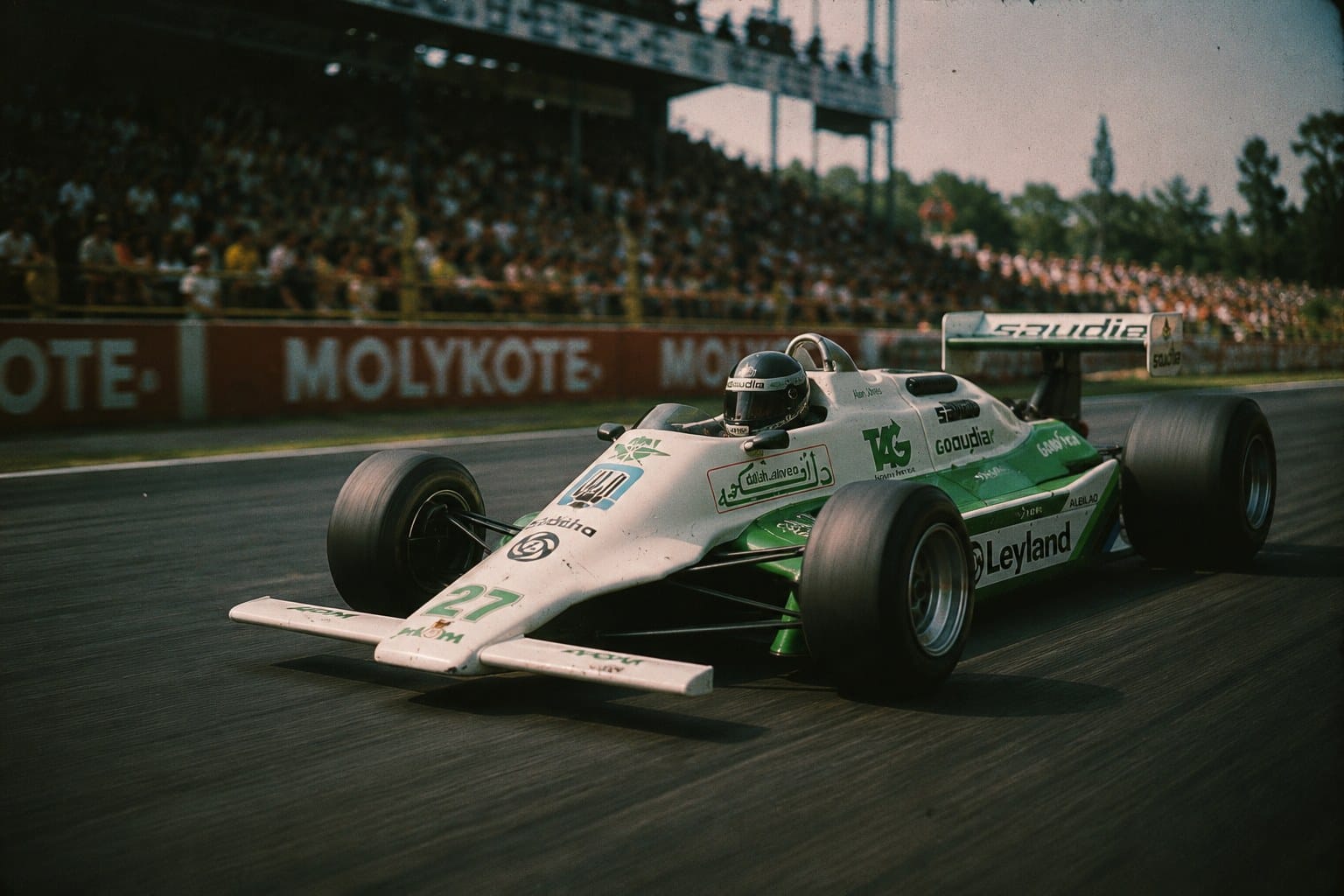

Frank Williams had had to wait a long time for it. For years he ran a team teetering on the edge of bankruptcy, with second-hand cars and sponsors who kept walking away. The turning point came at the end of the seventies, when he brought in two things that changed everything: money from the Middle East — Saudia, the Saudi airline, together with Albilad, TAG and Dallah Avco — and an engineer called Patrick Head. Head understood ground effect, the aerodynamic revolution Lotus had unleashed, and applied it to the FW07.
In 1979 that car brought Williams its first ever Grand Prix wins. But 1979 was only the dress rehearsal. For 1980 Head sharpened the design into the FW07B: stiffer suspension, improved ground-effect tunnels and the reliability to last a whole season. Under the engine cover sat the trusty old Ford Cosworth DFV — a 3.0-litre V8 that by then nearly everyone was using, but which Williams put to just slightly better use than the rest.
In the cockpit of number 27 sat Alan Jones, an Australian with the physical toughness of a boxer. He drove hard, he did not complain and he was exactly the kind of driver Frank Williams was looking for. Alongside him, in no. 28, was the elegant Argentine Carlos Reutemann. The season got off to a good start straight away: Jones won the opening race in Argentina, despite spinning twice. What followed was a long two-way fight with the young Nelson Piquet in the Brabham.
The turning point came in midsummer. In France and at Brands Hatch Jones won two races in a row and took the lead in the championship. From then on he never let it go. In Canada, at the penultimate race, Piquet retired with a broken engine while Jones drove to victory — enough to secure the world title with one race still to go. For good measure he also won the season finale at Watkins Glen. Five victories, the drivers' title and, for Williams, its very first constructors' title.
It was the beginning of a dynasty. Williams would become champion several more times in the decade that followed, but 1980 remains the year it all started — the first 'crown', won with a clenched fist. This model in my collection wears the unmistakable white-and-green Saudia livery, the broad number 27 and the Leyland sticker on the nose: a miniature of the car that put a small English team on the map for good.