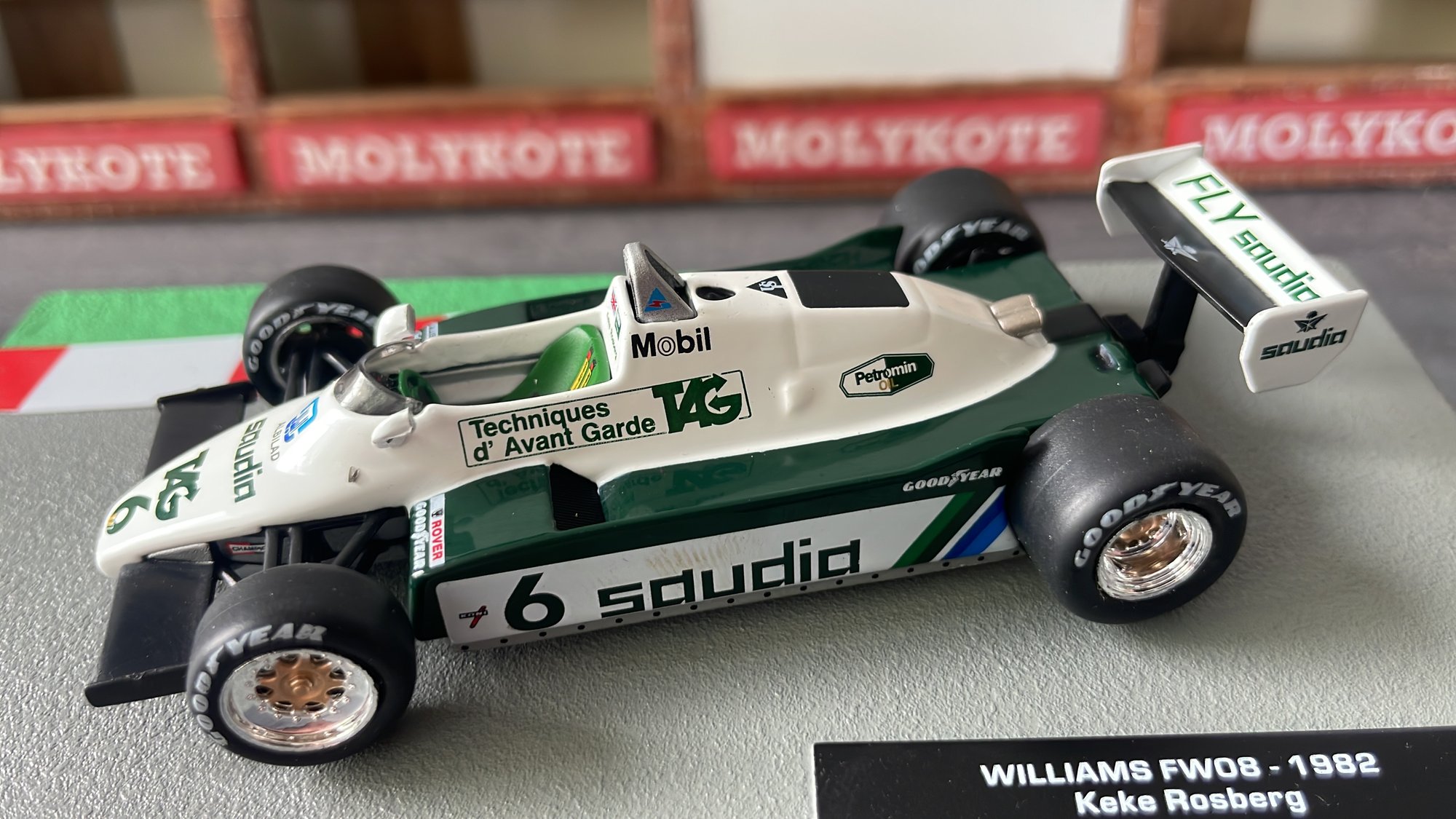
Keke Rosberg joined Williams in 1982 as the replacement for Alan Jones, who was retiring. By then he had already driven six seasons in Formula 1, for teams such as Theodore, Wolf and Fittipaldi. Never won a Grand Prix. Often not even scored a point. A Finnish driver with a moustache, a cigarette between every spare lap and no equipment other than what weaker teams could give him. At Williams he was in a top car for the first time.
The season was a shambles from the very first race. The South African GP opened with a drivers' strike — the drivers demanded better contracts and locked themselves in a hotel in Sandton. The FOCA teams then boycotted the San Marino GP. Gilles Villeneuve was killed during qualifying in Belgium, Riccardo Paletti in Canada. Niki Lauda came out of retirement for McLaren. Brabham experimented with pit stops for fuel. Nobody knew any more which way it was all heading.
The Williams FW08 was the somewhat smaller, shorter successor to the FW07. Patrick Head designed it strictly for ground effect, in the last season the concept was still allowed. For 1983 the FIA would make flat bottoms compulsory. At the same time the turbo engines of Renault and Ferrari were closing in — and the FW08 still relied on an old-fashioned Ford Cosworth DFV. That engine was twelve years old and simply no longer fast enough.
Yet Rosberg became world champion that year. Not because he dominated, but because everyone else took turns to drop out. He won one race (Switzerland — at Dijon!), but finished on the podium six times and was almost always in the top four. In the end his margin over Pironi and Watson was five points. It was the last year in which a driver became champion without a dominant car — and the very last year of the DFV at its best.
And then there was that six-wheeled FW08B. Patrick Head had built a version with four small wheels at the back — more rubber on the road, less drag, and above all better ground effect. The car was tested extensively, but before it could be raced the FIA banned six-wheeled cars. As far as is known, it is the only six-wheeled F1 car never to have run in a Grand Prix.