
For Williams, the 1999 season was the low point of a decade. The team that had won five constructors' titles in the nineties suddenly found itself without a works engine: Renault had left, and what remained was the same V10, developed further and sold under the name Supertec. A customer engine, with everything that goes with it. Gavin Fisher drew the chassis, Geoff Willis the aerodynamics, Patrick Head oversaw it all — and the result, the FW21 in the red and white of Winfield, was tidy but nowhere near dominant. Ralf Schumacher took three podiums with it and all of the team's thirty-five points; Alessandro Zanardi, back from America with two CART titles to his name, did not score a single one. Fifth in the constructors' championship. For Williams, that was a humiliation.
But behind those disappointing figures, work was already under way on something else. BMW was to join as works engine supplier from 2000, and to put that new V10 through its paces Williams built a modified chassis: the FW21B. No longer a racing car, but a laboratory on wheels. When the 2000 season arrived and the real cars headed off to the circuits, the FW21B stayed behind — with a new client.
Michelin had pulled out of Formula 1 in 1984 and wanted to come back. Not half-heartedly, but well prepared: a manufacturer that turns up with fresh tyres for a modern high-downforce car after sixteen years away simply no longer knows how that car will behave. So Michelin leased one FW21B from Williams, complete with BMW V10, at a reduced price, and set up its test operation from the factory in Grove. From early 2000 the car ran sessions of four days in a row — at BMW's own Miramas in the south of France and at Barcelona — where data on grip, wear and behaviour in the wet was gathered systematically.
The drivers used for this were not star names but professionals. Jörg Müller — Formula 3000 champion in 1996, later a BMW works driver in touring cars — was the regular test driver of the BMW-Williams project between 1999 and 2001 and drove both the engine and the tyre programmes. Alongside him, Bruno Junqueira, Darren Manning, Tom Kristensen and occasionally Ralf Schumacher himself took the wheel. The famous shoot-out at Jerez, in which Junqueira and a nineteen-year-old Jenson Button fought for the second Williams seat, also took place in this same chassis. Button won that contest; the engineers were divided.
The work paid off. In 2001 Michelin was back on the grid, with Williams as its first partner, and the tyre war against Bridgestone began that would shape the years that followed. Of the car that made it possible there is no results list, no points total, no lap of honour. Only kilometres.
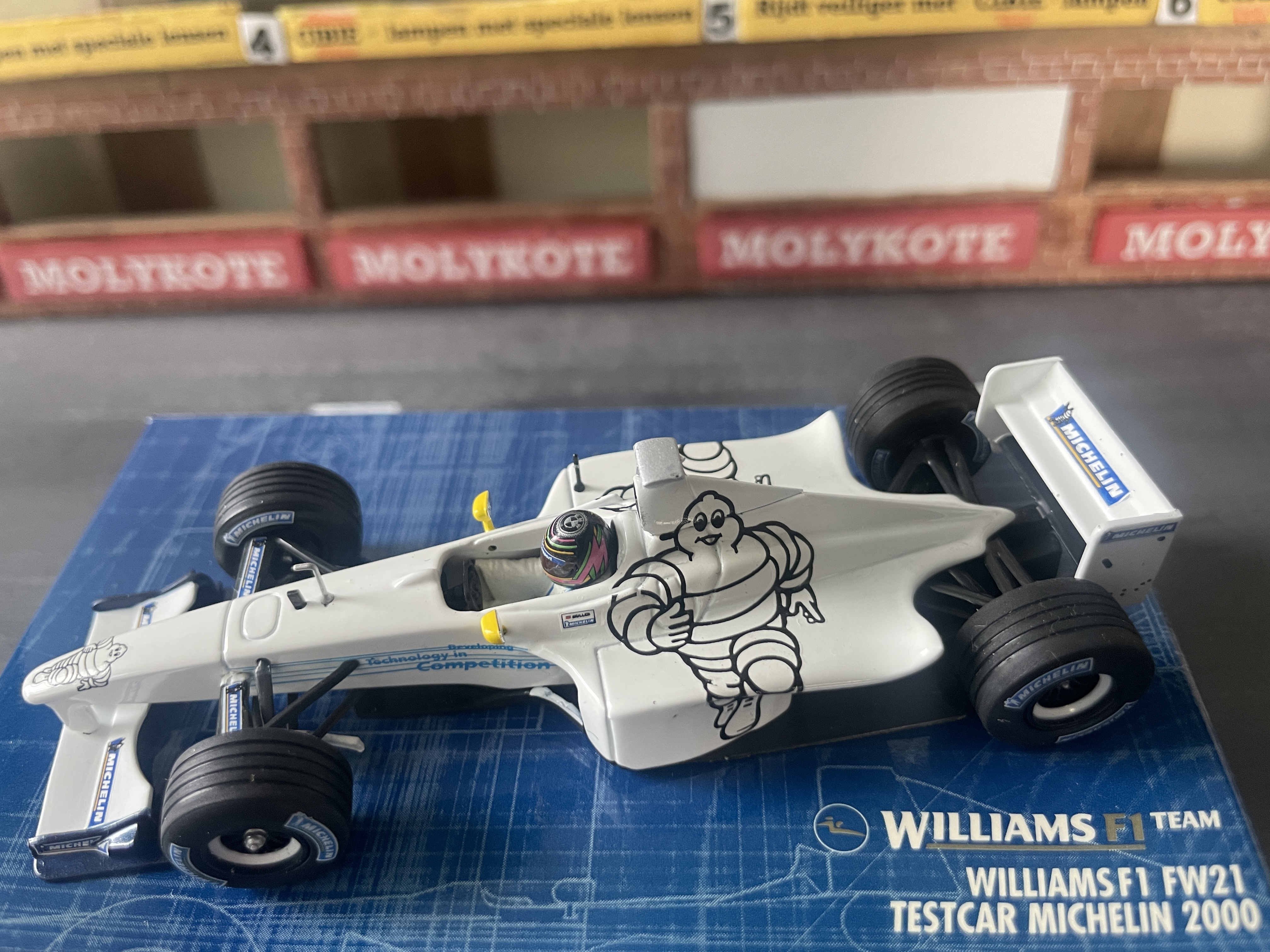
That is exactly why this model is such a curious thing to put in a display cabinet. It is brilliant white — no Winfield red, no cigarette brand, no race number on the nose. On the sidepod is Bibendum, the Michelin Man, drawn in black lines large across the flank, with the line Developing Technology in Competition along the nose. Michelin logos on the wings, on the wheels, on the tyres themselves. Minichamps released it in a limited edition of 5,999 pieces; I found one somewhere for nine euros. A car that never ran in a Grand Prix, but without which the decade that followed would have looked different.