By the end of 1976 Walter Wolf had had enough of watching from the sidelines. The Austrian-born businessman, who had made his fortune in Canada trading in oil-industry and diving equipment, had bought into Frank Williams' team a year earlier. That marriage did not run smoothly, and when Williams left to set up his own, brand-new team, Wolf was left with the workshop, the equipment and the people. His team was therefore, however strange it may seem, the direct continuation of the first team Frank Williams had ever set up — while Williams himself started again from scratch. For 1977 Wolf wanted only one thing: a car of his own, and the best people around him.
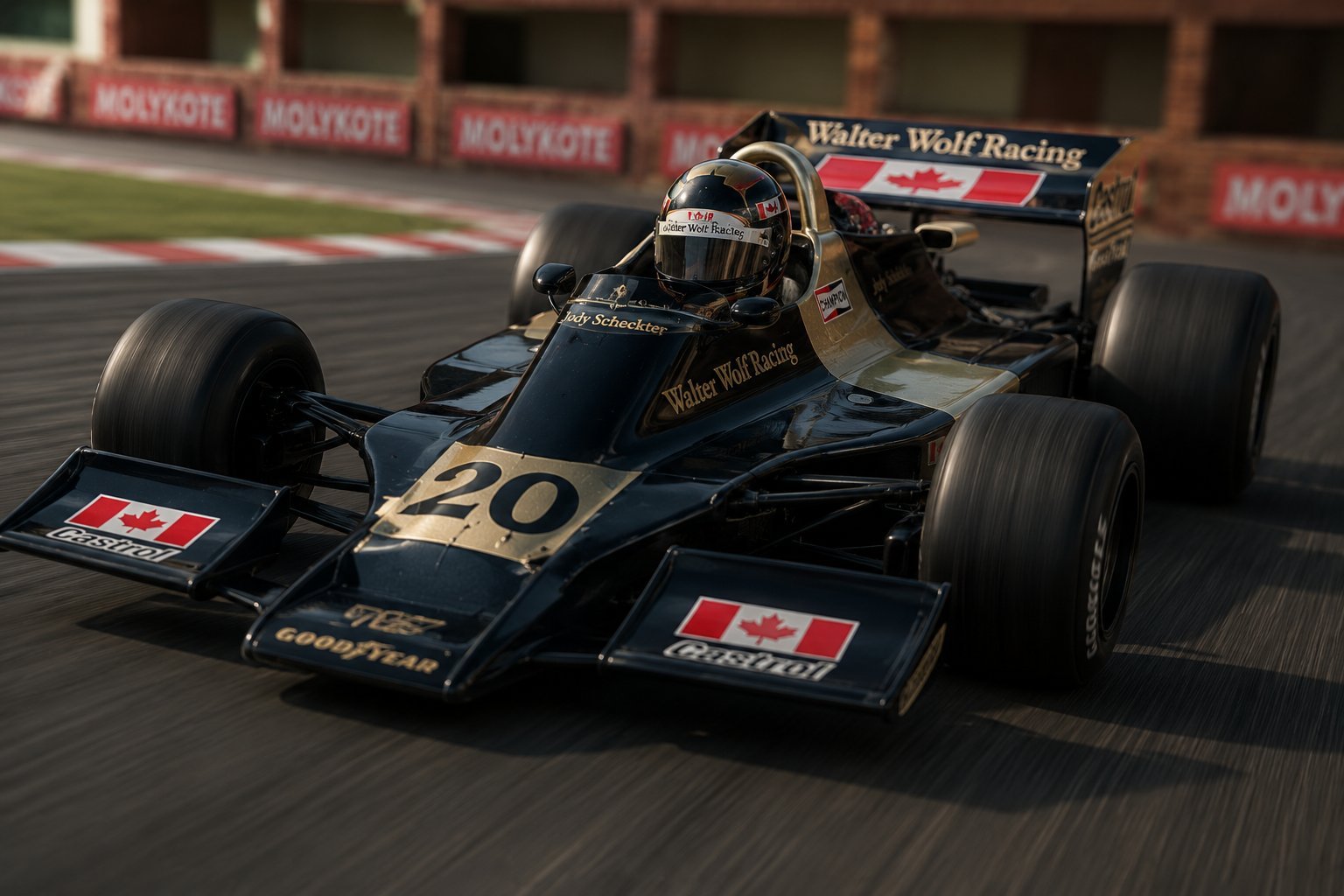
He found those people. As designer he lured Harvey Postlethwaite away from the defunct Hesketh team; as team manager Peter Warr came over from Lotus. Postlethwaite drew a remarkably simple car: an aluminium monocoque with the trusted Ford-Cosworth DFV V8 as a stressed member at the back, handsome lines and a carefully balanced weight distribution. No experiment, but a car that did everything well. It became the WR1 — Walter Wolf Racing, chassis one. The team ran just one car per race, a rarity in a field full of multi-car entries, with number 20 and, as its driver, Jody Scheckter, the taciturn South African who had left Tyrrell behind.
The debut came on 9 January 1977 in Buenos Aires. James Hunt was on pole and in the lead, and nobody was looking at the black-and-gold newcomer that had started eleventh. But the Argentine heat wore down one car after another, and when Hunt's suspension also failed on lap 31, Scheckter suddenly found himself in front. He did not give up the lead again and won by more than forty seconds. It was the very first Grand Prix of a brand-new constructor — and it was won at the first attempt, a feat that had almost never happened in the history of Formula 1.
Argentina proved to be no fluke. In Monaco Scheckter won again, in a tense, tactical race between the barriers. At the team's home circuit in Canada, Mosport, the third win followed. In between, the WR1 strung the podiums together: second in South Africa and Germany, third at Long Beach, in Spain, at Zandvoort and at Watkins Glen. Nine podiums in one season, with one car and one driver. At the end of the year Scheckter was second in the world championship with 55 points; only Niki Lauda and his Ferrari stayed out of reach.
The team would never climb so high again. The success of 1977 was partly a matter of perfect timing and reliability, and when the competition arrived with ground effect in 1978, the simplicity of the WR1 was overtaken. Scheckter left for Ferrari, where he became world champion in 1979. That same year James Hunt joined Wolf — the man who had been on pole in Buenos Aires — but the shine had gone; halfway through the season Hunt abruptly quit. Shortly afterwards the team was absorbed into Fittipaldi's.
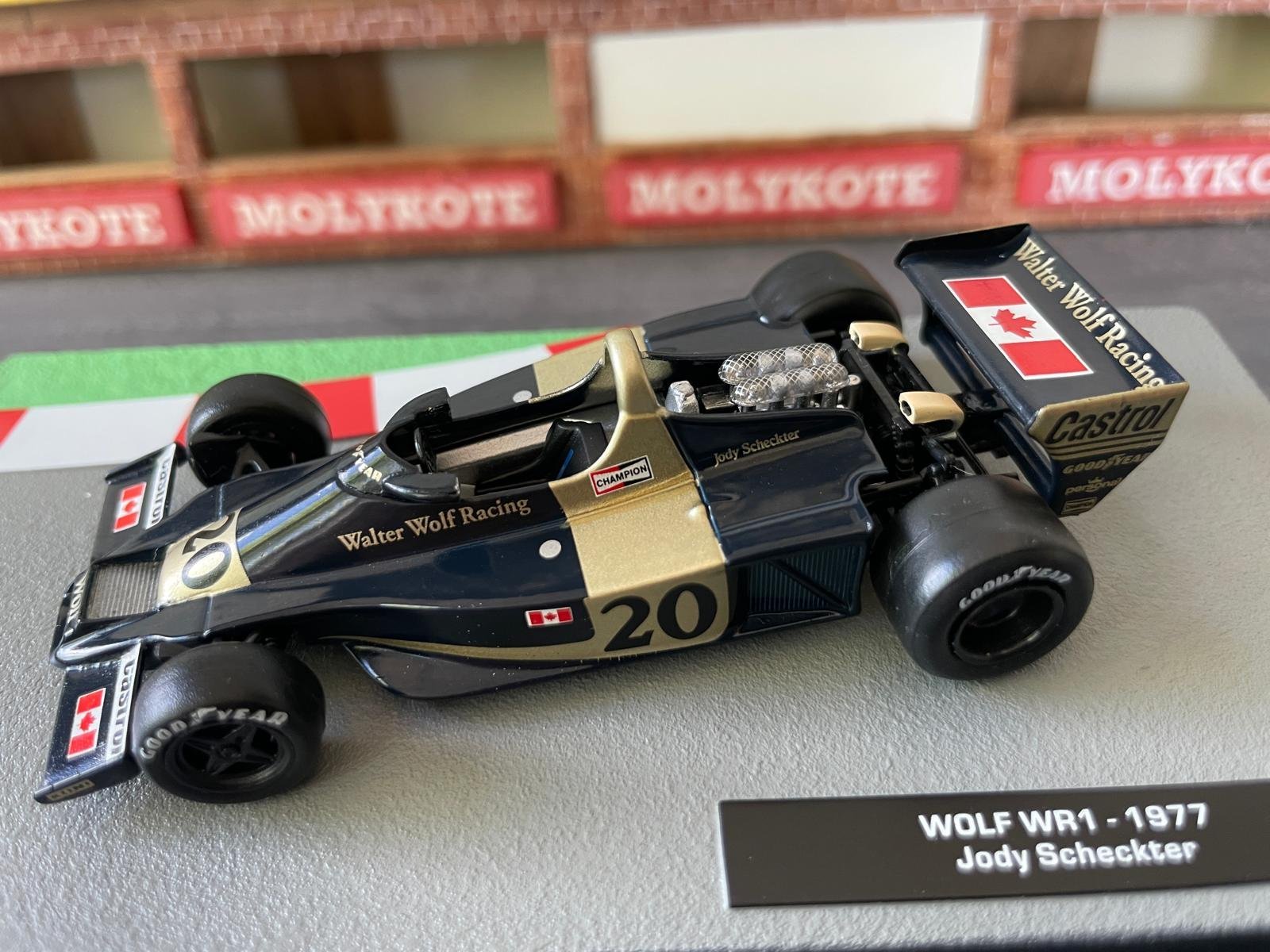
This model in my display cabinet wears exactly the colours of that one golden year: the deep midnight blue-black, the gold pinstripe, the Canadian maple leaves for Wolf's adopted homeland, and the broad number 20. A quiet reminder of a team that appeared out of nowhere, won straight away, and vanished just as quickly.